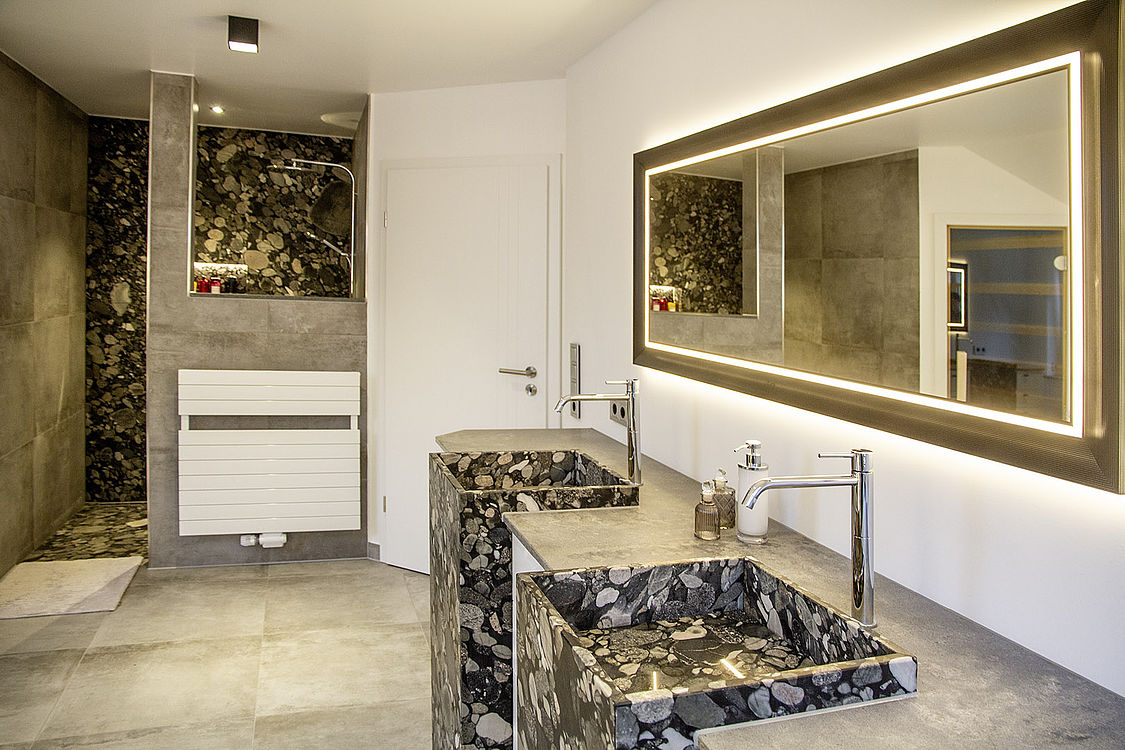
Background. Caesarstone was founded in 1987 in Kibbutz Sdot Yam in Israel and is regarded as one of the pioneers of industrial engineered quartz slab production. The company produces its slabs by the Bretonstone® vacuum vibro-compaction process and has been among the globally leading brands in this material segment for decades. The version presented here, 4033 Rugged Concrete, comes from the brand's Concrete series (4xxx coding), which in design terms is aimed at raw, ground fair-faced concrete and industrial render impressions – within it, Rugged Concrete is arguably the most expressive, most distinctly “concrete-like” version.
Material build-up. A classic Caesarstone quartz slab consists of around 90–93 % natural quartz (SiO₂), about 7–10 % polymer binder on a polyester resin base as well as pigments and mineral additives. Quartz has a Mohs hardness of 7 (against calcite marble at Mohs 3) – which makes engineered quartz slabs considerably more scratch-resistant, more acid-resistant and free of pores. In spring 2024, alongside the classic quartz line, Caesarstone brought the Mineral™ line to market, in which a large part of the crystalline quartz was replaced by other mineral aggregates – this change is a direct response to the global discussion of silicosis risk during fabrication; the grade documented here, 4033 Rugged Concrete, corresponds to the historical quartz mix.
The 4033 Rugged Concrete version. In design terms Rugged Concrete is one of the most characterful slabs in the Concrete series. The ground tone is a mid to dark grey, slightly cool anthracite. Distributed across the ground are pronounced cloud and wipe marks in lighter and darker greys as well as subtle whitish veils that look like float, wipe or formwork marks on raw fair-faced concrete. The composition is deliberately designed to be “imperfect” – unlike smoothly ground architectural concrete, Rugged Concrete quotes an aged, hand-worked concrete with a visible material history. From a medium distance the slab reads as a powerful, rough fair-faced concrete statement; close up, the fine modulation of the tonal values and the stylised wipe marks become apparent.
Format and fabrication. Caesarstone supplies the slabs in the standard format 306 × 144 cm as well as in the jumbo format 327 × 162 cm, in 2 and 3 cm thicknesses; individual lines also in 1.2 cm and 0.6 cm (Caesarstone Slim) for wall claddings and furniture fronts. The slabs can be cut, profiled, drilled and edge-worked with diamond tooling. Standard edges are square, chamfered (V-chamfer, 45°), rounded (R3, R5) and finished profile edges such as bullnose or a mitred edge joint for 90° corner connections. The surface finishes available from stock are listed in the »Finishes« block further down.
Technical values. A Caesarstone quartz slab reaches typical bulk densities of around 2,100 kg/m³, a water absorption of about 0.02–0.05 % (clearly below the level of natural marble), compressive strengths in the range of 200–300 MPa and flexural strengths of 35–80 MPa. These values clearly qualify the material for heavily loaded interior fit-out applications.
Thermal and chemical properties. Engineered quartz is considerably more acid-resistant than marble, because the quartz aggregates themselves are inert to acid and the polyester accounts for only a small share of the volume. Even so: strongly concentrated acids (hydrochloric, sulphuric, nitric acid) and aggressive industrial chemicals attack the binder. Heat tolerance extends to roughly 150 °C for short periods; hot pots, frying pans or baking trays must never be set down directly on the surface, because direct point heat can cause discolouration or stress cracks. UV resistance is limited – the slab is clearly designed as an interior material and should not be permanently installed in fully sunlit conservatories or open loggias.
ROSSITTIS range. The surface finishes available from stock are listed in the »Finishes« block further down. From these we produce kitchen worktops (standard and island), vanity tops, wall claddings (including kitchen splashbacks and bathroom walls), bar counters, reception desks, buffet and furniture tops, interior stairs with treads and risers as well as window sills. The powerful fair-faced concrete look comes into its own most strongly as an island or bar counter element, set against pale cabinet fronts or white wall colours; combined with brass, bronze, Corten steel, oiled timber or black sanitary fittings, the typical industrial premium look emerges.
Comparison. Within the Concrete series, Rugged Concrete is arguably the most characterful grade – with markedly more visible wipe and formwork marks than the calmer 4030 Oyster or the lighter 4011 Cloudburst, and without the warm taupe character of 4023 Topus or 4230 Shitake. Compared with genuine fair-faced concrete, the slab remains predictable, immediately ready for installation, possible in considerably thinner gauges and free of any carbonation or drying phase. Compared with porcelain with a concrete decor (Laminam Calce, Florim Magnum Concrete, Neolith Beton), the slab feels warmer to the touch and is less brittle, but is overall somewhat less resilient thermally and chemically.
Guarantee and brand. On its slabs in residential applications Caesarstone offers the “Caesarstone Forever” lifetime warranty, with clearly defined care and fabrication conditions. The brand is established Europe-wide among architects, interior fit-out contractors and premium kitchen studios.
An honest assessment. 4033 Rugged Concrete is a statement slab for clients and architects who want the full, strongly characterful fair-faced concrete feel – with all its wipe and workmanship marks, but without getting entangled in the building realities of real concrete (carbonation, cracks, long drying times, acid sensitivity). Anyone looking for a calmer, more even concrete feel is better served by 4030 Oyster or 4044 Airy Concrete; anyone who wants raw, site-real concrete without any staging should reach for the genuine material.