Ceramic slabs combine the look of natural stone with the benefits of industrial production: an even appearance, high stain resistance and XXL formats up to 330 cm. Fired at over 1,200 °C, they are extremely hard, scratch-proof and UV-stable.
The surfaces are non-porous — liquids cannot penetrate and bacteria find no hold. Where natural stone reaches its limits, whether with acid-sensitive surfaces or extreme large formats, is where ceramics come into their own.
ROSSITTIS carries ceramics by Laminam, ABK Stone, Caesarstone Keramik and Optimum Surfaces — filter by colour and format.
 119 slabs
LAMINAM® Diamond Cream
 100 slabs
Description to follow
100 slabs
Description to follow
CTX BasicKeramik® ABK Calacatta Gold
 98 slabs
LAMINAM® Pietra di Savoia Grigia
 79 slabs
LAMINAM® Nero Greco
 80 slabs
LAMINAM® Noir Desir
 76 slabs
Description to follow
76 slabs
Description to follow
CTX BasicKeramik® ABK Calacatta Grey
 73 slabs
LAMINAM® Ardesia Nero
 75 slabs
LAMINAM® Calacatta Michelangelo
 69 slabs
CTX BasicKeramik® ABK Base Pearl
 70 slabs
LAMINAM® Collection Bianco Assoluto
 66 slabs
Description to follow
66 slabs
Description to follow
CTX BasicKeramik® ABK Trani Beige
 66 slabs
Description to follow
66 slabs
Description to follow
LAMINAM® Oxide Avorio
The leading ceramic manufacturers in the ROSSITTIS range — each brand with its own design profile and range of formats.
Large-format ceramic
Laminam is the Italian pioneer of large-format ceramic slabs, founded in 2001 in Fiorano Modenese. Formats up to 324 × 162 cm in thicknesses from 3 to 20 mm make seamless surfaces possible in the kitchen, in the bathroom and on the façade. Over 100 decors – from the true-to-nature marble reproduction (I Naturali) through cement and metal looks to vivid solid colours.
More on Laminam →simply ROSSITTIS
CTX-BasicKeramik is the own brand of ROSSITTIS, manufactured by ABK Stone in Emilia-Romagna – Italy's ceramic heartland. High-grade ceramic with natural-looking surfaces and particular depth of colour, from an authentic marble look to a modern concrete look. Uncompromising quality at an attractive price-performance ratio.
More on CTX-BasicKeramik / ABK Stone →A new perspective
Caesarstone is extending its portfolio with a ceramic line that combines the brand's design expertise with the technical advantages of porcelain. UV-resistant, heat-resistant and available in large formats – a new perspective on surfaces for the kitchen, the bathroom and architecture.
More on Caesarstone Ceramics →330 × 184 cm large format
Optimum Surfaces supplies technical ceramic in XXL large format up to 330 × 184 cm. Extreme load capacity, UV resistance and frost resistance make Optimum the first choice for façades, outdoor areas and demanding interior projects. The format is conceived as a waste-optimised cut for kitchen worktops – a single slab yields the work surface, the splashback and the sides with minimal offcut.
More on Optimum Surfaces →Ceramic positions itself as the technically most superior surface material: harder than granite (Mohs 8–9 vs. 6–7), UV-resistant (unlike engineered quartz), heat-resistant and acid-proof. Compared with granite, ceramic offers zero care effort and larger formats. Compared with engineered quartz, ceramic offers heat resistance and outdoor suitability. The disadvantage: ceramic is more brittle than both competitors and does not offer the feel and the uniqueness of natural stone.
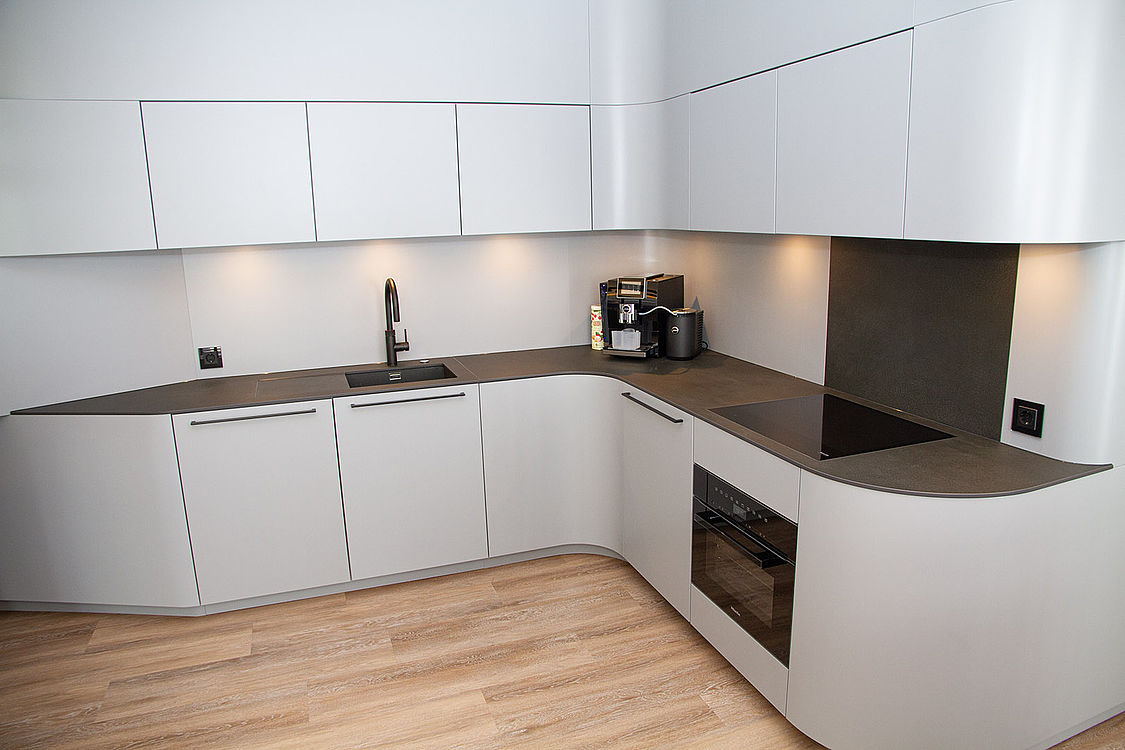
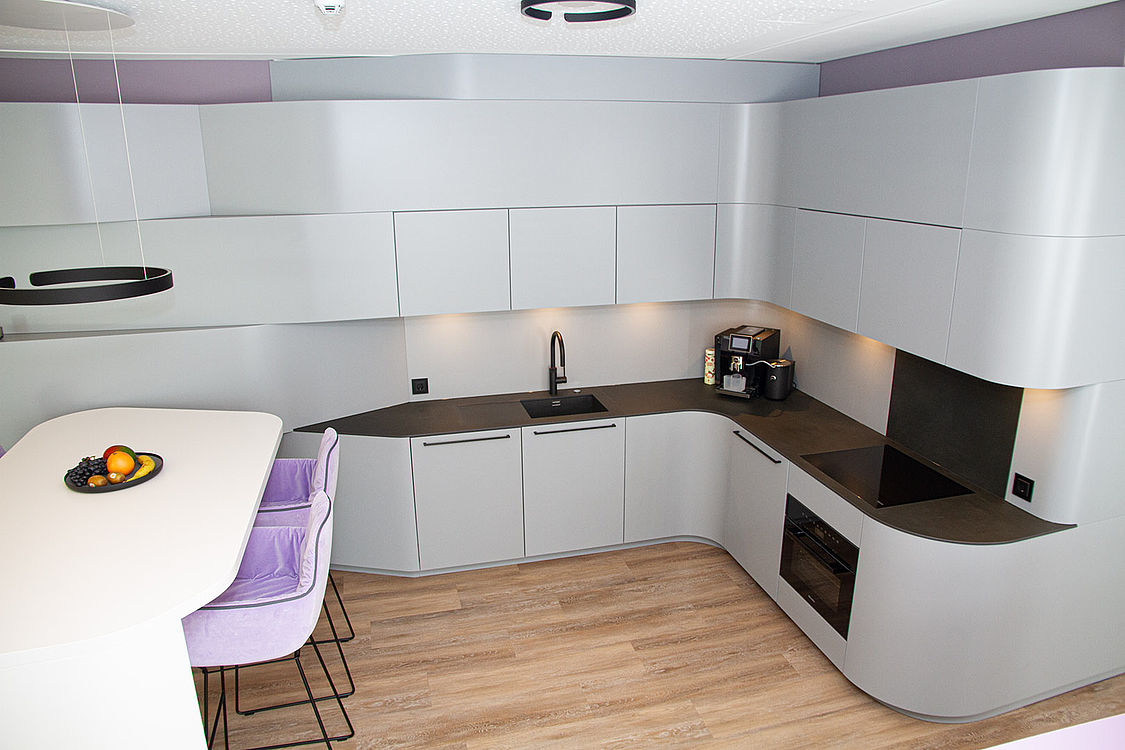
Kitchen worktops – the main area of use. Ceramic combines heat resistance, acid resistance and hygiene with seamless large formats. The splashback can be cut from the same slab. Note: with extreme differences in temperature (a hot pot straight from the oven onto a cold slab) we recommend trivets, in order to avoid thermal shock.
Façades (!) – UV-resistant, frost-proof and weather-resistant. Ceramic is the material of choice for rear-ventilated façades in modern architecture. Self-cleaning surfaces reduce the maintenance effort.
Bathrooms – washstands, shower walls and floor areas. The non-porous surface prevents mould from forming and is resistant to all common cleaning agents.
Furniture and interior architecture – tables, reception counters, shelves and doors. Thin formats (3–6 mm) make ceramic the lightweight alternative to natural stone.
Rear-ventilated façades – large formats up to 330 cm allow impressive façade images with minimal joints.
Floor coverings – abrasion-resistant, slip-resistant (depending on the finish) and, in thin formats, able to be laid directly over an existing covering.
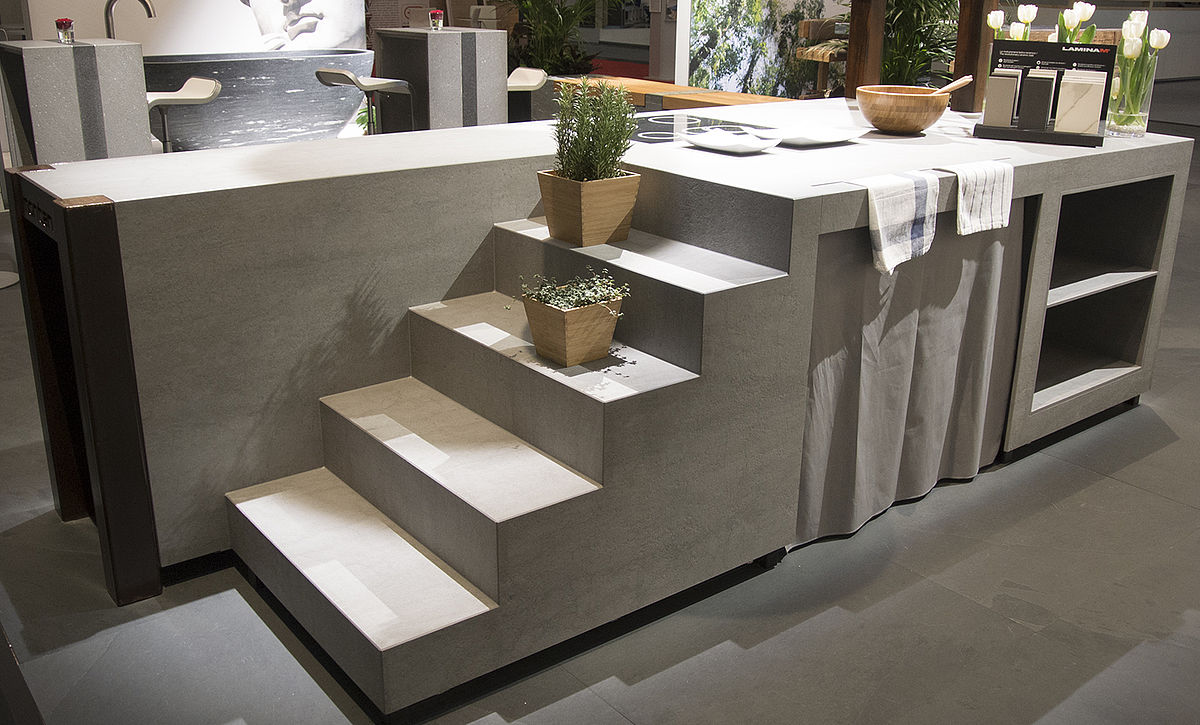
Projects in which Ceramics has been used to great effect.
Ceramic for surfaces – also referred to as large-format ceramic, porcelain stoneware or sintered ceramic – is an industrially produced high-performance material made from natural raw materials. Clay minerals, feldspar, quartz sand and pigments are pressed under extreme pressure of over 400 bar and then fired (sintered) at over 1,200 °C.
The result is a virtually pore-free material with a water absorption of practically zero. Through the sintering process the raw materials fuse into a homogeneous mass that is harder than granite, UV-resistant, frost-proof and fully acid-resistant.
The formats available are impressive: large-format ceramic today reaches formats of over 330 cm in length – large enough for seamless kitchen worktops, shower wall claddings and façade elements. Thicknesses range from 3 mm (wall cladding, furniture) to 20 mm (worktops, façades). Specific formats and thicknesses per brand can be found further down in the brand comparison.
Important: ceramic is not a natural stone but an industrially produced product. It offers the aesthetics of natural materials – marble, concrete, metal, wood – with superior functionality. Food-safe, recyclable and, in its technical performance, almost unmatched.
Typical value ranges for ceramic slabs. Individual brands may differ.
Ceramic offers a profile of technical properties that no other surface material achieves in this combination. With a hardness of Mohs 8–9, ceramic is more scratch- and abrasion-resistant than granite and engineered quartz. Water absorption is practically zero (< 0.1 %), and the surface is fully resistant to acids and chemicals.
UV resistance makes ceramic the only industrial surface material that can be used outdoors without hesitation – without fading or discolouration. Frost-resistant, fire-resistant (class A1) and with a flexural strength that permits large overhangs. Limitation: as with all ceramic materials, the risk of fracture under a strong point impact is higher than with natural stone.
The design variety of modern ceramic surpasses every other surface material.
Marble reproductions form the premium segment: Calacatta, Statuario, Carrara and Arabescato in a deceptively real look – with the acid resistance that genuine marble lacks.
Cement and concrete looks serve the industrial trend: matt, tactile surfaces with an authentic patina for lofts and modern kitchens.
Metal effects – rust, patina and copper looks create surfaces that no other material can reproduce.
Wood looks – warm wood grains on a material that neither swells nor shrinks.
Solid colours – from the purest white to deep black, in matt, silk and gloss. Minimalism in perfection.
Ceramic is the lowest-maintenance surface material there is.
No impregnation needed: the completely closed surface absorbs no liquids – neither water nor oil nor acid.
Daily cleaning: warm water with any cleaning agent is enough. Ceramic tolerates even aggressive cleaners, scouring agents and disinfectants without damage.
Heat: ceramic is heat-resistant and does not discolour from hot pots. Sudden differences in temperature (a very hot pot on a very cold slab) can, however, lead to thermal shock cracks – we recommend trivets with extreme sources of heat.
Caution: avoid strong point impacts on edges and corners. Particular care is called for during transport and installation.
Ceramic is an industrially produced material made from natural raw materials (clay, feldspar, quartz sand) that are sintered at over 1,200 °C. Natural stone is quarried and cut, but not industrially formed. Ceramic offers a uniform appearance, zero care effort and UV resistance; natural stone offers a unique feel and natural character.
Depending on the application, ceramic slabs are available in thicknesses from 3 to 20 mm. 3–6 mm for wall claddings and furniture, 12 mm for kitchen worktops and 20 mm for façades and floor coverings. The thin formats are particularly light and can be bonded directly onto existing surfaces.
Yes, ceramic is UV-resistant, frost-proof and weather-resistant. It is outstandingly suited to façades, terraces, outdoor kitchens and pool surrounds. Unlike engineered quartz, ceramic does not fade from exposure to sunlight.
Ceramic slabs are worked with diamond tools (wet cutting machines, CNC routers). Cut-outs for sinks, hobs and taps are possible, but they require experience and special tooling. Fabrication should be carried out exclusively by a qualified stonemason.
The formats vary from manufacturer to manufacturer. Laminam supplies up to 324 × 162 cm, Optimum Surfaces even up to 330 × 184 cm. These large formats make seamless kitchen worktops, shower walls and façade elements with minimal joints possible.
Yes. Ceramic is fully food-safe and hygienic. The non-porous, closed surface absorbs no liquids or bacteria. Ceramic is therefore also approved for professional catering and for healthcare.
We carry Laminam (Italy, large formats up to 324 × 162 cm), CTX-BasicKeramik / ABK Stone (Italy), Caesarstone Ceramics and Optimum Surfaces (large format up to 330 × 184 cm). Each brand has its own design profile and range of formats.