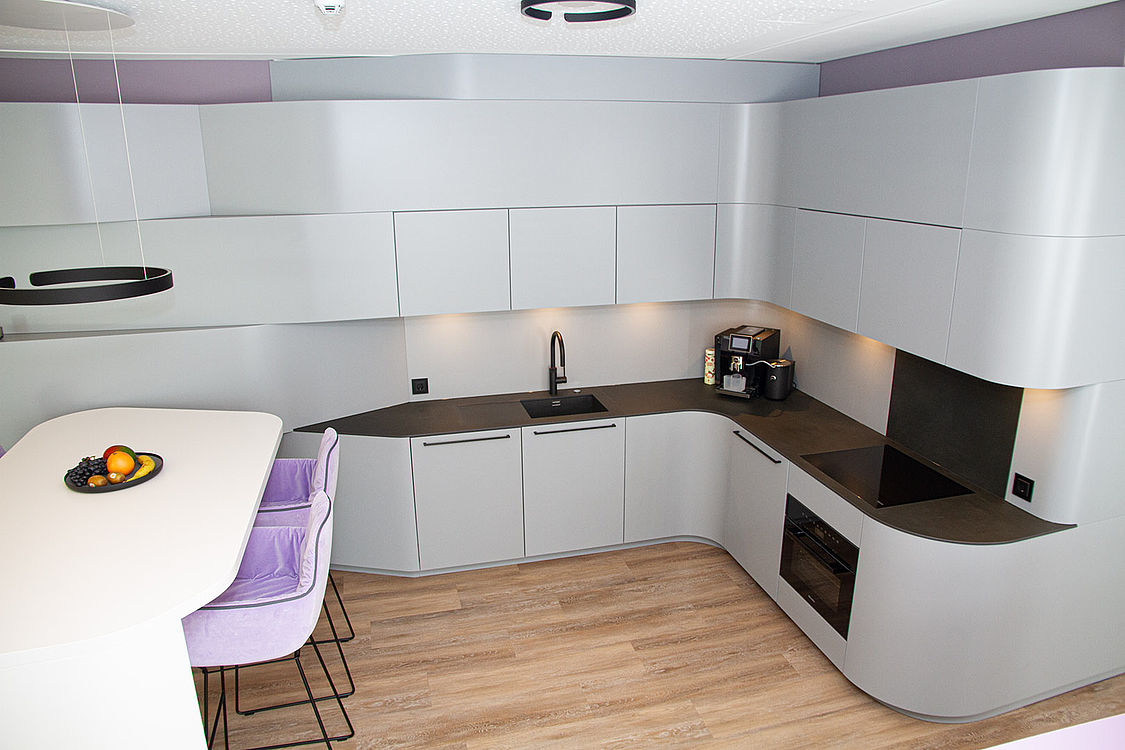
Background. Laminam® is the Italian premium brand for porcelain large-format slabs, founded in 2001 in Fiorano Modenese (province of Modena) as a subsidiary of the System group. Laminam is one of the European pioneers of large-format porcelain and has played a decisive part in shaping the format of thin, large mineral slabs in design terms. The company produces in Italy, supplies architects and interior fitters worldwide and is an established name among German premium kitchen studios and interior architecture practices.
Material structure and manufacture. A Laminam slab consists of around 100 % mineral raw materials – feldspar, quartz, clay minerals and pigments – without polymer binders. The mixture is compacted in a patented pressing process in a mould, provided with decorated pigment layers for the appearance and then sintered at temperatures above 1,200 °C in a tunnel kiln. In this sintering the mineral particles partly fuse into a closed crystalline mineral structure – the end product is a fully mineral, through-sintered slab with no resin content. From this follow decisive technical advantages over engineered quartz: water absorption below 0.1 %, very high heat resistance (hot pans can be set down directly), full UV resistance and therefore suitability for external use, frost resistance and almost complete acid resistance.
The Calce collection. "Calce" (Italian for "lime") is Laminam's collection with a fair-faced concrete and lime plaster character. Unlike the expressively patinated slabs of the Ossido line, the Calce family is characterised by maximum quietness and a calm, even material effect – an allusion to hand-applied, ground lime plaster or to precise architectural concrete. The family typically comprises several variants in different tonal values: Calce Nero (black, documented here), Calce Bianco (white), Calce Cenere (mid-grey ash) and others.
The Calce Nero variant. Calce Nero is the uncompromisingly darkest grade of the Calce line. The ground tone is a deep, slightly warm-toned anthracite black – not a pure coal black, but a characterful dark shade with a subtle warm underground. The slab shows a finely textured, velvety mineral surface with the finest glaze and wipe marks, which reads like a high-quality applied, ground black lime plaster. In contrast to the Ossido Nero slab with its pronounced patina and mineral rust structures, Calce Nero remains calmer, more even and architecturally more reduced. The naturale matt base surface underlines the lime plaster character optimally.
Format and thicknesses. Laminam supplies the slabs in several large formats – the standard format is around 162 × 324 cm and 100 × 300 cm. The thicknesses are graded in 3, 5, 12 and 20 mm; the 3 and 5 mm slabs are particularly suited to wall claddings, furniture fronts, interior doors and façades, while the 12 and 20 mm slabs are standard for kitchen worktops and bar counters (frequently with a mitred edge joint for a visibly thicker look). The low thickness at 3 mm is a central Laminam advantage – it allows lightweight furniture fronts, interior doors and rainscreen façade panels to be realised as well.
Thermal and chemical properties. Unlike engineered quartz, there is no polyester resin here – so the typical weaknesses fall away: Calce Nero is heat-proof (hot pans can be set down directly, the slab is unaffected well beyond 200 °C), almost completely acid-proof (wine, lemon, tomato, vinegar leave no traces) and fully UV-stable (suitable for external use). Frost and weather resistance are given.
Slip resistance. Certain Calce Nero variants have R10 slip resistance to DIN 51130 – this makes the slab certified for use in floor applications in areas with water contact (bathroom, pool surround, external area) as well. When ordering, the exact surface variant with its slip resistance classification should be confirmed.
ROSSITTIS range. The surface finishes available from stock are listed in the »Finishes« block further down. From these we fabricate kitchen worktops (standard and island with mitred edge), vanity tops, wall claddings (including kitchen splashbacks and bathroom walls), bar counters, reception counters, furniture fronts (cabinet, drawers, door), interior doors, interior stairs with treads and risers, window sills, interior floors, external floors, pool surrounds and façade elements. The calm black lime plaster character comes across most strongly in purist modern architecture with timber, metal and concrete accents.
Comparison. Within the Laminam portfolio, Calce Nero is the calmest variant of the dark slabs – in contrast to the dramatically patinated Ossido Nero, the high-contrast veined Noir Desir and the classically veined Nero Greco. Stylistically related are the other variants of the Calce line and competing products such as Neolith Iron Grey or Dekton Domoos. Compared with real black lime plaster or fair-faced concrete, the porcelain remains predictable, heat- and acid-proof, without the structural variation, long drying times and acid sensitivity of real mineral plasters. Compared with Caesarstone engineered quartz grades with a similar décor (4120 Raven, 3100 Jet Black), the Laminam slab is more heat-proof and fully UV-stable.
Guarantee and brand. Laminam offers a lifetime guarantee on its slabs in residential use for material and manufacturing defects. The brand is established across Europe among architects, interior fitters and premium kitchen studios.
Honest assessment. Calce Nero is a choice for clients and architects looking for a genuinely calm, uncompromisingly dark material with a lime plaster character, without dramatic staging or pronounced veins. The slab works particularly strongly as a façade panel, as a furniture front, as a wall cladding and as an interior or external floor in purist architectural concepts. Anyone looking for a dramatic play of veins or powerful patina structures should reach for Noir Desir, Nero Greco or Ossido Nero.