
Anorthosit from Angola

Listed in our range under Granite.

Brown Antique

Brown Antique is a dark brown anorthosite of the granite family from Angola with a metallic shimmer and a strong effect of depth. At ROSSITTIS it is used for worktops, stairs, façades and high-quality dark interior and exterior surfaces.

Anorthosit Angola 2.900 kg/m³
Available as: Slabs, Skirting, Tiles and flooring slabs, Crust slabs · 6 of 165 reserved
Other trade names: Angola Brown, Antique Brown, Baobab Brown, Braun Antik, Marrom Antique, Marron Cohiba, RO-01-465, RO-01-670, Van Dyke

About Brown Antique

Brown Antique belongs to those dark natural stones that generate warmth and depth at the same time. The material shows a dark brown to almost black overall pattern with metallically shimmering crystal zones and warm brown layers. This makes the stone appear luxurious without presenting itself as hard-black as Nero Assoluto. On kitchen worktops, stairs, wall surfaces and dark floor areas in particular, Brown Antique therefore works very well: present, high-quality and at the same time somewhat more domestic than a pure black tone.

In stock

Current availability from our warehouse.

165 slabs in stock — 159 available now, 6 reserved · plus 63 blocks

Thicknesses: 1–10 cm · Finishes: Polished, Satin-honed, wengé-plus wen-pec®-plus · Available as: Slabs, Skirting, Tiles and flooring slabs, Crust slabs

Updated daily from our live stock.

Technical data

Guide values for the stone type, taken from manufacturer and test reports. Natural stone is a natural product — individual batches and slabs can differ. For critical applications, request slab-specific test data.

Rohdichte 2.900 kg/m³
Druckfestigkeit 115,0 MPa
Biegezugfestigkeit 17,7 MPa
Wasseraufnahme 0,11 %

Finishes

Brown Antique is available in a range of finishes. The finish affects appearance, feel and the care it needs.

Polished

Polishing is the most classic finish in the hard stone segment — a mirror-smooth, high-gloss surface with the highest possible colour intensity and maximum depth effect in the mineral structure. As an acid-resistant silicate stone, polished granite is easy to care for and the first choice for kitchen worktops, wall claddings and prestigious exposed surfaces.

Satin-honed

The satin surface is created by brushing, which selectively removes softer minerals and gives the surface a slight depth. A matte appearance with subtle light reflection and a warm feel to the touch. Easy to maintain, insensitive to scratches and suited to everyday use — a popular alternative to a polish in modern kitchens and living spaces.

Wengé-plus wen-pec®-plus

An intensified version of the wengé special finish, with more pronounced texturing and a stronger depth effect in its wood-like character. A design-led finish for statement wall claddings and decorative accent surfaces; technical details and availability on direct request.

Care & fabrication

Brown Antique should be sealed after installation, particularly on kitchen worktops and dark floors. The very low water absorption of 0.10–0.11 % is strong, but a sealer makes cleaning and maintenance easier still.

For cleaning and maintenance, pH-neutral natural stone cleaners, water and a soft microfibre cloth are sufficient. On polished dark surfaces, water and limescale marks should not be allowed to dry on.

Avoid strongly abrasive products and aggressive specialist chemistry not approved for natural stone. Coffee, oil, wine or coloured foods should be removed promptly from worktops, so that the deep dark effect is preserved.

Outdoors, regular cleaning, good drainage and a finish appropriate to the use matter more than aggressive deep cleaning. Frost is technically well manageable with this material.

Frequently asked questions

Is Brown Antique suitable for a kitchen?

Yes. Brown Antique reaches 2,730–3,070 kg/m³ bulk density, 105.0–124.9 MPa compressive strength, 15.2–20.1 MPa flexural strength and only 0.10–0.11 % water absorption. It is therefore very well suited to kitchen worktops.

Which finishes are available for Brown Antique?

The surface finishes currently held in stock are listed in the »Finishes« block on this page.

Where does Brown Antique come from?

Brown Antique comes from Angola. The stone is traded internationally as a dark brown granite with a metallic shimmer.

How do I clean Brown Antique correctly?

For cleaning and maintenance, a pH-neutral natural stone cleaner with a soft cloth is sufficient. On polished dark surfaces, limescale and grease residues should not be allowed to dry on.

Is Brown Antique frost-resistant?

Yes, the material has been tested after freeze-thaw cycles and, at 0.10–0.11 % water absorption, is well suited to external applications, provided the build-up and the finish are right.

Brown Antique or Tan Brown – which is better?

Tan Brown usually appears somewhat quieter and more classically patterned, Brown Antique darker and more metallic. Anyone looking for more depth and shimmer is often better served by Brown Antique.

What does Brown Antique cost?

The price depends on the batch, thickness, surface finish and fabrication — with natural stone there is no serious flat rate per square metre. Business customers see prices once their B2B account is activated; private customers receive a complete quote through a fabricator near them.

Projects using Brown Antique

Projects in which Brown Antique has been used successfully.

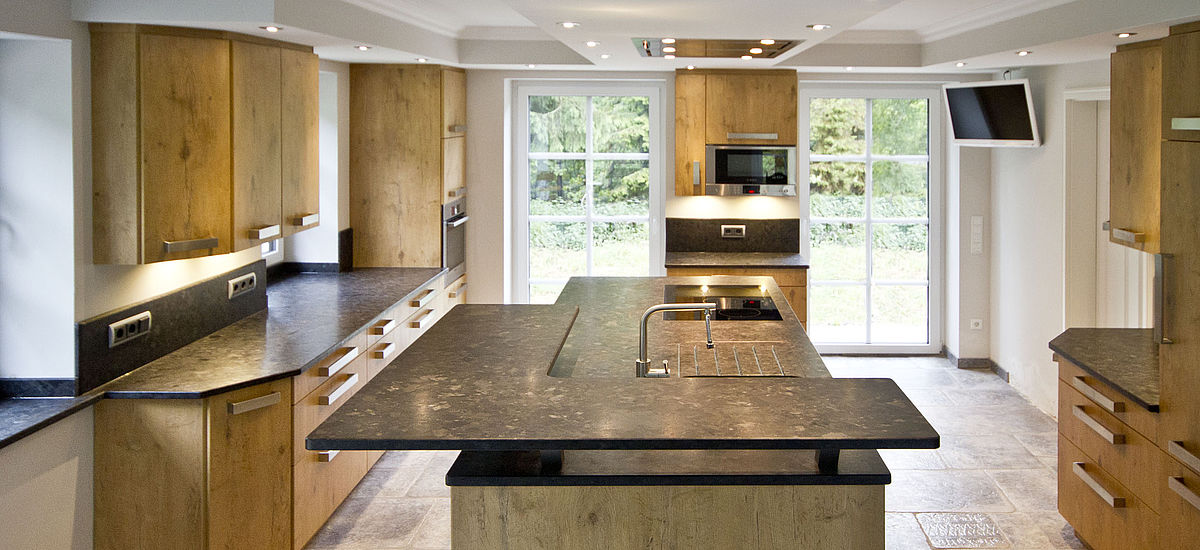
Brown Antique Küchen

Brown Antique

Steinfuchs

Check the live stock Request an appointment