
Gneiss from Angola

Listed in our range under Granite.

Belvedere

Belvedere is a black gneiss from Angola, traded as a hard stone: strongly folded light bands in beige, white and gold run across a black-grey ground. For kitchen worktops, vanity tops, wall cladding, floors and stairs indoors.

Gneiss from Angola, traded as a hard stone (sometimes also labelled quartzite or granite). Not to be confused with the visually similar Brazilian gneiss Cosmic Black.

Gneiss Angola Säurebeständig
Available as: Slabs, Skirting, Tiles and flooring slabs · 10 of 174 reserved
Other trade names: African Fusion, Andromeda Black, Fortemoro, Occhio di Drago, RO-01-605, Saint Laurent Quarzite

About Belvedere

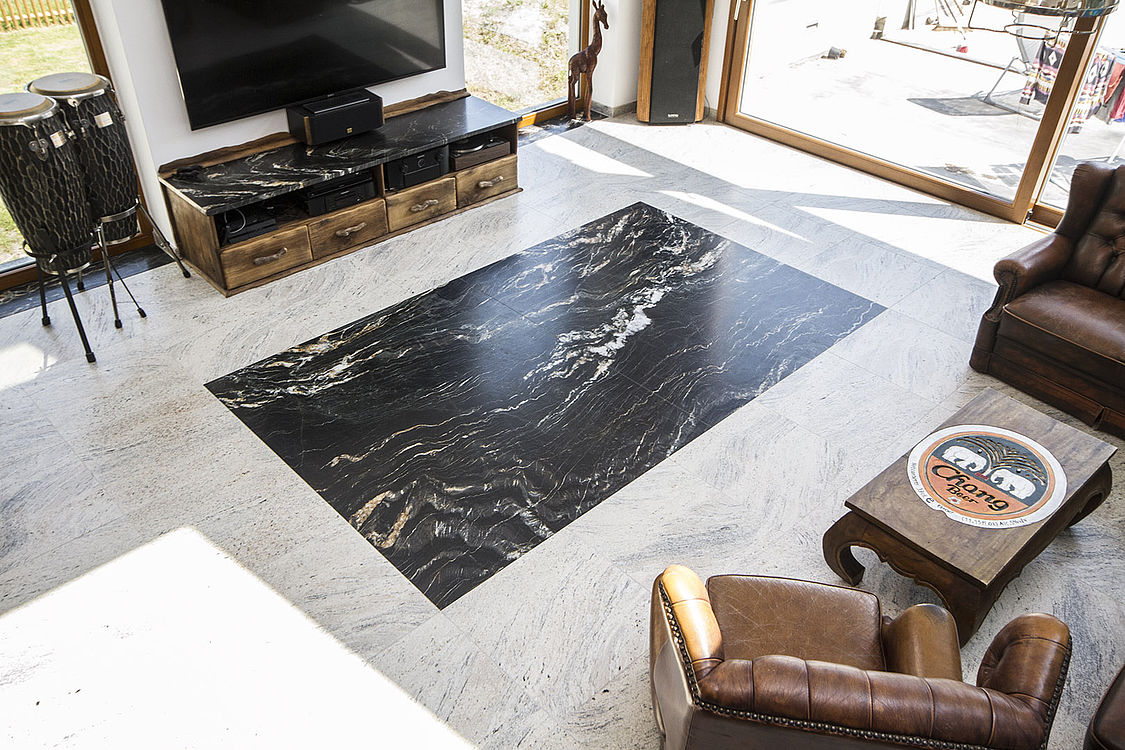
Belvedere is all about contrast. Across a black to black-grey ground run light bands in beige, white and warm gold, strongly folded and in places softly clouded. The pattern still shows the direction in which the rock once flowed and deformed. The light inclusions make Belvedere more varied than a plain black material, and in everyday use the surface looks less sensitive as a result.

Geologically, Belvedere is a gneiss: a metamorphic rock reshaped from older rocks under pressure and heat. It comes from southern Angola and is well over a billion years old; ore content in the rock produces the warm golden tones. In the trade Belvedere is listed as a hard stone and is sometimes also offered as quartzite or granite.

In stock

Current availability from our warehouse.

174 slabs in stock — 164 available now, 10 reserved · plus 34 blocks

Thicknesses: 1–3 cm · Finishes: Polished, Satin-honed, River finish and more · Available as: Slabs, Skirting, Tiles and flooring slabs

Updated daily from our live stock.

Technical data

Guide values for the stone type, taken from manufacturer and test reports. Natural stone is a natural product — individual batches and slabs can differ. For critical applications, request slab-specific test data.

Säurebeständig Ja

Suitability by application

Particularly suited to

Finishes

Belvedere is available in a range of finishes. The finish affects appearance, feel and the care it needs.

Polished

Polishing is the most classic finish in the hard stone segment — a mirror-smooth, high-gloss surface with the highest possible colour intensity and maximum depth effect in the mineral structure. As an acid-resistant silicate stone, polished granite is easy to care for and the first choice for kitchen worktops, wall claddings and prestigious exposed surfaces.

Satin-honed

The satin surface is created by brushing, which selectively removes softer minerals and gives the surface a slight depth. A matte appearance with subtle light reflection and a warm feel to the touch. Easy to maintain, insensitive to scratches and suited to everyday use — a popular alternative to a polish in modern kitchens and living spaces.

River finish

The surface is roughened by water pressure and then given a colour-enhancing treatment — the shade comes through more strongly than on the flamed-and-brushed variant. Recommended for outdoor areas, terraces and façade claddings that call for a level, slip-resistant surface with a powerful depth of colour.

Care & fabrication

Belvedere should be impregnated after fabrication. Impregnation makes cleaning easier and helps keep polished dark surfaces looking clean in daily use.

pH-neutral natural stone cleaners, clear water and a soft microfibre cloth are sufficient for cleaning. On large dark surfaces, water residue and greasy streaks should be removed regularly to preserve the depth of the surface.

Avoid highly abrasive pads and aggressive special cleaners. Oil, coffee or staining foods should not be left on the surface for hours.

In kitchens, bathrooms and showers it makes sense to check the impregnation regularly and refresh it when its effect wears off.

Frequently asked questions

What kind of stone is Belvedere?

Belvedere is a gneiss from Angola, a metamorphic hard stone. In the trade it is listed as a hard stone and is sometimes also offered as quartzite or granite.

Where does Belvedere come from?

Belvedere comes from southern Angola. It should not be confused with Cosmic Black, a visually similar gneiss from Brazil.

Belvedere or Cosmic Black – what is the difference?

Both are black gneisses with light golden, flowing veining and look very much alike. Belvedere comes from Angola, Cosmic Black from Brazil. They are two different materials; the specific slab decides which one suits better.

Is Belvedere suitable for kitchens?

Yes. As a silicate hard stone, Belvedere is much less sensitive to acids than black marble and is suitable for kitchen worktops and islands. Impregnation makes care easier.

Which finishes are available for Belvedere?

The surface finishes available from stock are listed in the »Finishes« block on this page.

How do I clean Belvedere properly?

A pH-neutral natural stone cleaner is sufficient. On dark polished surfaces, water residue, grease films and limescale should be removed regularly.

Belvedere or Nero Marquina?

Nero Marquina is a black marble and sensitive to acids. Belvedere is a gneiss and more robust in everyday use. Visually, Nero Marquina is clearly black and white, while Belvedere has more movement, with beige and gold tones.

What does Belvedere cost?

The price depends on the batch, thickness, surface finish and fabrication — with natural stone there is no serious flat rate per square metre. Business customers see prices once their B2B account is activated; private customers receive a complete quote through a fabricator near them.

Projects using Belvedere

Projects in which Belvedere has been used successfully.

Belvedere / Cielo White Böden

Belvedere / Cielo White

Marmor Freitag in Olfen

Check the live stock Request an appointment