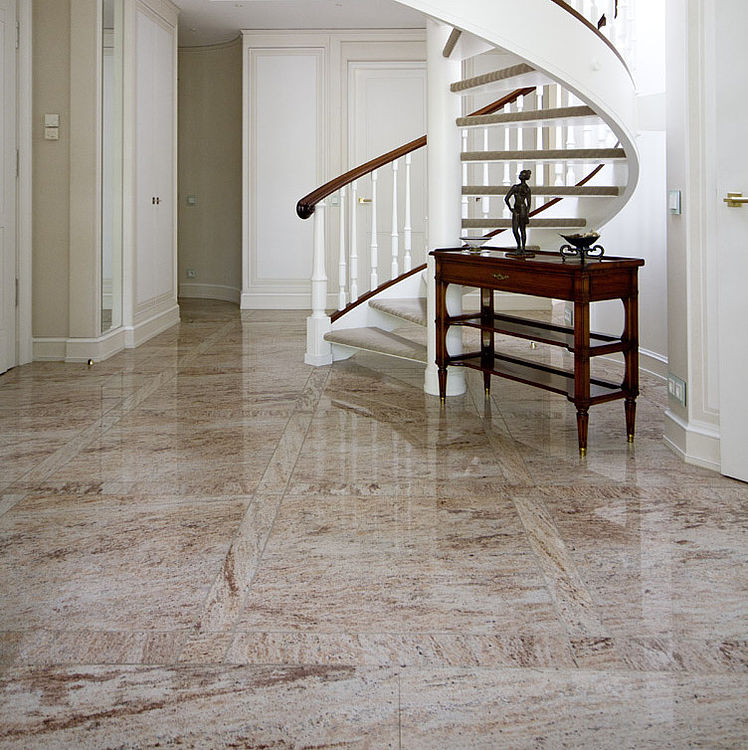
Migmatit from India

Listed in our range under Granite.

Ivory Brown

Ivory Brown is a classic Indian migmatite from the Sivakasi quarry district in the south of Tamil Nadu — internationally known above all under its main name Shivakashi (Shivakasi). The groundmass is a warm creamy ivory to golden beige, interspersed with characteristic burgundy-red to copper-brown garnet speckles and flowing vein bands. Used for kitchen worktops, bar counters, wall claddings, façades and prestige interior and external surfaces with a warm, elegant appearance.

Ivory Brown ist petrographisch ein präkambrischer Migmatit aus dem Sivakasi-Bruchgebiet (Tamil Nadu, DNSA #3833 als SHIVAKASHI), wird im Handel jedoch als Granit geführt.

Migmatit India Frostbeständig Säurebeständig 2.755 kg/m³
Available as: Slabs, Skirting, Paving slabs, Tiles and flooring slabs · 4 of 176 reserved

Other trade names: Astoria Granite, Chiffon Beige Granite, Colonial Dream, Golden Rose, Ivory Beige Granite, Ivory Brown Extra Granite, Ivory Brown Granite, Ivory Brown Light Extra Granite, Ivory Brown Light Granite, Ivory Chiffon Gold Granite, JUPA ROSE, Kashi Brown, SHIVAKASHI, Sahara Sun Morbillo, Shiva Gold Granite, Shivakashi Granite, Shivakashi Ivory Granite, Shivakasi Gold Granite, Shivakasi Granite, Sivakasi Brown Granite, Sivakasi Gold Granite, Sivakasi Ivory Brown Granite, Sivakasi Ivory Granite, Tropical White

About Ivory Brown

Ivory Brown lives from a warm, elegant material effect with the classic Indian Shivakashi character. The ground tone is a warm cream beige to ivory gold with subtle honey-yellow undertones, interspersed with characteristically clustered burgundy-red to copper-brown garnet speckles that emerge from the pale groundmass like small embers. These red garnet accents are the stone's striking visual hallmark and distinguish it from more neutral cream granite classics. Added to this are black and dark grey biotite dots as well as fine flowing vein bands in burgundy brown. On a polished surface the stone develops a warm, glowing depth with the characteristic play of light of the garnet accents — a material for architecture that wants to combine warm natural elegance with a lively material effect.

In stock

Current availability from our warehouse.

Technical data

Guide values for the stone type, taken from manufacturer and test reports. Natural stone is a natural product — individual batches and slabs can differ. For critical applications, request slab-specific test data.

Rohdichte 2.755 kg/m³
Druckfestigkeit 159,5 MPa
Biegezugfestigkeit 12,9 MPa
Wasseraufnahme 0,26 %
Frostbeständig Ja
Säurebeständig Ja

Suitability by application

Particularly suited to

Finishes

Ivory Brown is available in a range of finishes. The finish affects appearance, feel and the care it needs.

Poliert

Politur ist die klassischste Veredelung im Hartgesteinsegment — eine spiegelglatte, hochglänzende Oberfläche mit höchstmöglicher Farbintensität und maximaler Tiefenwirkung der Mineralstruktur. Als säurebeständiges Silikatgestein ist polierter Granit pflegeleicht und für Küchenarbeitsplatten, Wandverkleidungen und repräsentative Sichtflächen erste Wahl.

Satiniert

Die satinierte Oberfläche entsteht durch Bürsten, das weichere Minerale gezielt entfernt und der Fläche eine leichte Tiefe gibt. Mattes Erscheinungsbild mit subtiler Lichtreflexion und haptisch warmer Wirkung. Pflegeleicht, kratzunempfindlich und alltagstauglich — beliebte Alternative zur Politur in modernen Küchen und Wohnräumen.

Geflammt + 1 x gebürstet

Die Oberfläche wird durch Hitze aufgeraut und einmal gebürstet, um scharfkantige Mineralreste zu glätten und loses Material zu entfernen. Etwas sanftere Haptik als rein geflammt, weiterhin rutschhemmend, Farbe weniger intensiv als poliert. Standardwahl für Außenbereiche, Terrassen und stark beanspruchte Bodenflächen.

Care & fabrication

As an Indian migmatite, Ivory Brown is a robust hard stone with low water absorption (0.24-0.27 %), DNSA-confirmed acid resistance and frost resistance, and a Mohs hardness of 6-7. Wine, lemon juice, vinegar, cola, bathroom cleaners or descalers leave no etch marks as they would on marble or limestone.

For interior applications we recommend a silane- or polysiloxane-based sealer at first installation. On polished surfaces, depending on use, 5-10 years can pass between refreshes of the sealer; on heavily used kitchen worktops or external applications, check every 2-3 years. The sealer protects against oil, grease and pigments penetrating deeply — on the pale creamy ivory groundmass, discolouration can otherwise show up visibly.

Daily care is carried out with a pH-neutral natural stone cleaner and a soft cloth or microfibre mop. Clear warm water is usually sufficient. Acidic cleaners are in principle unproblematic, but should nevertheless not be used, because they can attack the sealer. The finishes available from stock are listed in the »Finishes« block further down this page.

For kitchen worktops, Ivory Brown is very well suited: cut- and scratch-resistant, insensitive to heat (hot pots and pans can be set down directly for short periods, though prolonged heat exposure above 200 °C should still be avoided), DNSA-confirmed acid-resistant and with good stain repellency. The expressive ivory-golden surface with its red garnet accents conceals small marks of use remarkably well. The finishes available from stock are listed in the »Finishes« block further down this page. With its low water absorption the stone is fully stable against weathering — outstandingly suited to external façades, terraces, stairs and pool areas.

For pool surrounds, outdoor terraces and fountain surrounds a slip-resistant textured finish is mandatory — on polished external surfaces there is a high risk of slipping when wet. In areas with frequent salt contact (de-icing salt, pool chlorine) we recommend an additional annual refresh of the sealer.

Frequently asked questions

Is Ivory Brown the same as Shivakashi?

Yes — Ivory Brown is an international trade designation for the classic Indian Shivakashi (also Shivakasi). The DNSA documents both names under entry #3833 (SHIVAKASHI as the main name; IVORY BROWN, JUPA ROSE, SHIVA GOLD as trade aliases). Numerous grading variants are marketed worldwide under similar names: Ivory Brown Light, Ivory Brown Extra, Ivory Beige, Chiffon Beige, Sivakasi Brown, Sivakasi Ivory and more — all come from the same Sivakasi quarry region in Tamil Nadu.

What is Ivory Brown geologically — granite or migmatite?

Geologically, Ivory Brown is a Precambrian migmatite, a highly metamorphic mixed rock at the boundary between gneiss and incipient melting — confirmed by the DNSA under entry #3833. In international trade and at ROSSITTIS the stone is carried in the granite family, because it offers the same technical properties (hardness, acid resistance, frost resistance) and is worked in a similar way. The characteristic burgundy-red garnet speckles are metamorphic garnet crystals from the migmatite genesis.

Is Ivory Brown suitable for a kitchen worktop?

Very well suited. With a Mohs hardness of 6-7, low water absorption (0.24-0.27 %), a compressive strength of 158-161 MPa and DNSA-confirmed acid resistance, Ivory Brown is cut-, scratch- and heat-resistant and absorbs no acids from wine, lemon or vinegar. The expressive ivory-golden surface with its red garnet accents conceals small marks of use remarkably well. For a kitchen worktop with a warm, elegant material effect and full suitability for everyday use the stone is a very fitting and readily accessible choice.

Which finishes are available for Ivory Brown?

The finishes available from stock are listed in the »Finishes« block on this page.

Where does Ivory Brown come from?

Ivory Brown / Shivakashi comes from the quarries around Sivakasi (Virudhunagar district) and Salem in the south Indian state of Tamil Nadu — one of India's most important natural stone supply regions and for decades a classic standard for warm creamy migmatites. Internationally the stone goes under numerous synonyms: SHIVAKASHI, Shivakasi Granite, Ivory Brown Granite, Sivakasi Brown, Shiva Gold, Jupa Rose, Astoria Granite and more grading variants.

How do I clean and care for Ivory Brown?

As a migmatite, Ivory Brown is very easy to care for: daily care with a pH-neutral natural stone cleaner and a microfibre cloth is sufficient. We recommend sealing at first installation; for interior applications a refresh interval of 5-10 years depending on use, on heavily used kitchen worktops or outdoors check every 2-3 years. Acidic cleaners are in principle unproblematic, but should nevertheless not be used. On polished surfaces, dry cleaning with a polishing microfibre cloth after damp wiping is advisable.

Ivory Brown or Kashmir White — which fits better?

Both are warm creamy Indian migmatites with characteristic garnet accents, but with subtly different characters. Kashmir White shows a cooler, whitish-creamy ground tone with stronger burgundy-red garnet speckles and fine black biotite dots — lighter and more contrast-rich. Ivory Brown is warmer in ground tone with an ivory-golden shade and more expressive flowing vein bands in burgundy brown — warmer and with more movement in the slab. For classically pale white-creamy elegance, Kashmir White; for a warm ivory appearance with livelier veining, Ivory Brown.

Projects using Ivory Brown

Projects in which Ivory Brown has been used successfully.

Ivory Brown Böden

Ivory Brown

Wolff Natursteine

Check the live stock Request an appointment