Quartzite from Brazil

Azul Imperial

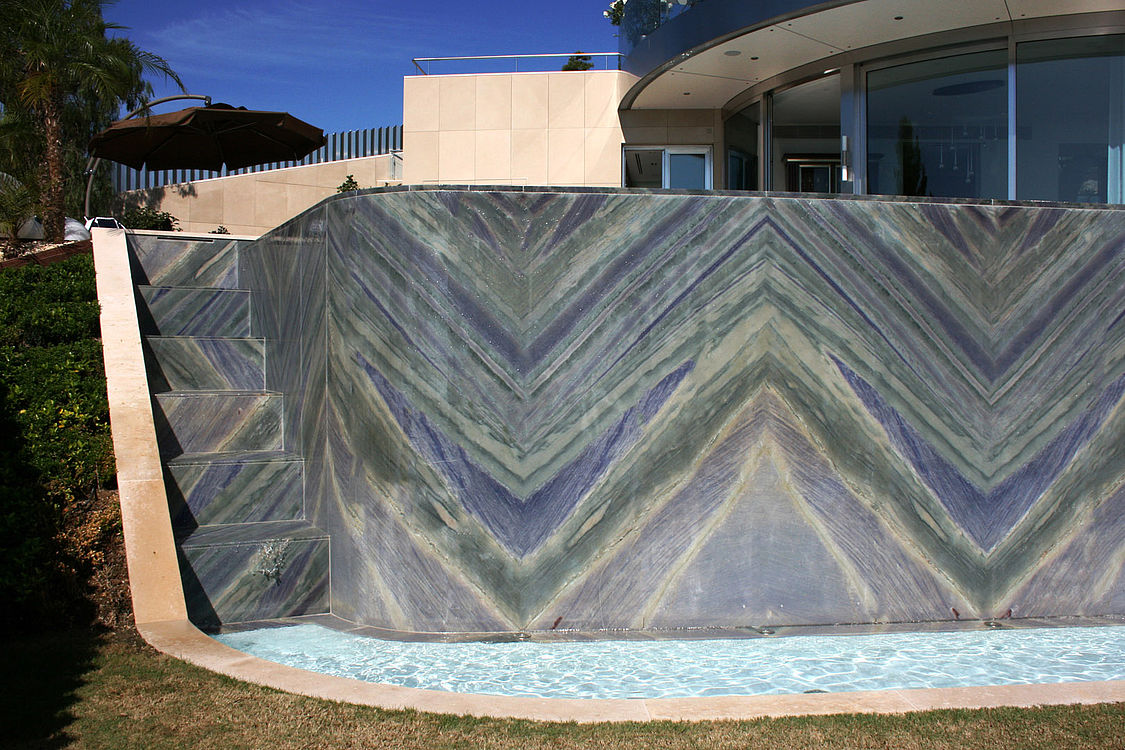
Azul Imperial is one of the rarest and most exclusive Brazilian quartzites — an exceptionally expressive Precambrian (around 1.2 billion years old) metamorphic quartzite from the quarrying area south of Oliveira dos Brejinhos in the state of Bahia, with a pastel blue to deep lavender-violet groundmass, flowing white and golden vein bands and directional movement structures. The unique blue colouring derives from rare dumortierite mineralisations. Also carried internationally as Imperial Blue Quartzite, Azul Imperiale and Imperial Sky Blue; used for expressive statement wall cladding, bookmatch settings, bar counters, designer kitchen worktops, fireplace surrounds and prestige internal surfaces with the highest design ambitions.

Quartzite Brazil 2.661 kg/m³
Available as: Slabs, Blocks, Skirting, Tiles and flooring slabs, Crust slabs · 13 of 2730 reserved

Other trade names: Azul Bahia Extra, Azul Imperial Verde, Azul Mediterraneo, Azul Pavone, Azul Renoir, Garda Blue, Pfauen-Quarzit

About Azul Imperial

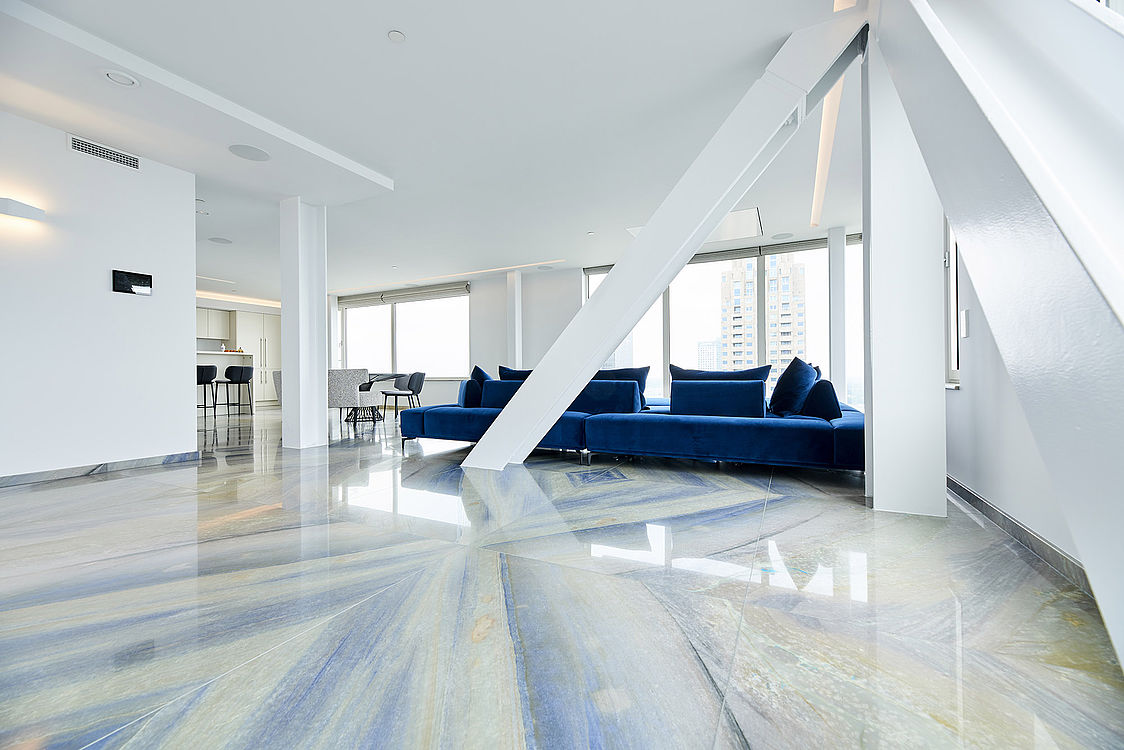
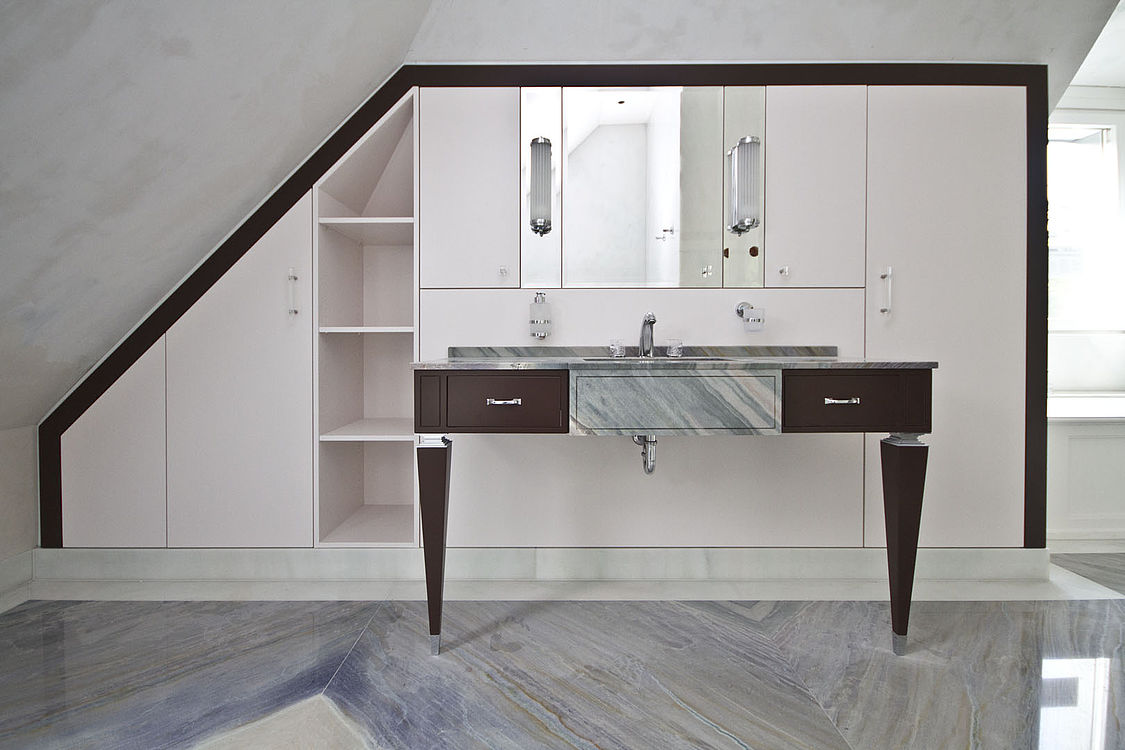
Azul Imperial is among the rarest and visually most impressive natural stones in the world. The slab image shows an exceptionally layered composition with a flowing, directional band structure in varying blue tones — from pale pastel blue-grey zones to deep lavender-violet areas with subtle transitions to beige, white and creamy layers. The individual bands usually run diagonally and recall frozen water currents or crumpled silk. Characteristic are the pronounced white quartz vein bands and the fine golden or honey-coloured accents that flow through the blue matrix and provide lively colour contrasts. Here and there, deeper violet cloud structures appear from denser dumortierite concentrations, while other zones read as pale and translucent. On a polished surface the stone develops an exceptional depth — the blue zones seem almost to glow, the vein bands shimmer silkily, and the whole stone reads like a summer sky set in stone or a gently flowing sheet of water. Every slab image is a unique one-off — with Azul Imperial it is particularly worth selecting from real slab images, because the distribution and intensity of the blue tones and the white vein bands vary strongly from block to block. The stone is exceptionally well suited to bookmatch installation (mirror-image laying), because the flowing band structures produce symmetrical, almost surreal large-scale motifs when two slabs are mirrored side by side — like reflecting water landscapes.

In stock

Current availability from our warehouse.

Technical data

Guide values for the stone type, taken from manufacturer and test reports. Natural stone is a natural product — individual batches and slabs can differ. For critical applications, request slab-specific test data.

Rohdichte 2.661 kg/m³
Druckfestigkeit 186,3 MPa
Biegezugfestigkeit 19,8 MPa
Wasseraufnahme 0,43 %

Finishes

Azul Imperial is available in a range of finishes. The finish affects appearance, feel and the care it needs.

Poliert

Politur ist die klassischste Veredelung für Quarzit — eine glänzende Oberfläche mit höchstmöglicher Farbintensität und ausgeprägter Tiefenwirkung. Je nach mineralischer Zusammensetzung kann die Wirkung stellenweise mattglänzend sein. Als Silikatgestein vollständig säurebeständig und kratzhart — ideal für Küchenarbeitsplatten und Sichtflächen.

Satiniert

Die Oberfläche wird gebürstet — weichere Minerale werden gezielt entfernt, es entsteht eine leichte Tiefe und mattes Erscheinungsbild. Geaderte Quarzite erhalten so eine besondere Charakteristik. Säurebeständig und kratzfest, pflegeleicht im Alltag — beliebte Alternative zur Politur in modernen Küchen und Wohnräumen.

Wengé wen-pec®

Sonderoberfläche mit charakteristischer Wengé-Holzanmutung — die Veredelung erzeugt eine längsgerichtete Strukturierung mit warmer, hölzern wirkender Haptik bei silikatischer Quarzit-Robustheit. Eine designorientierte Wahl für gestalterische Akzentflächen; technische Details und Verfügbarkeit auf direkte Anfrage.

Care & fabrication

As a Brazilian dumortierite-bearing quartzite, Azul Imperial is an exceptional material with specific care requirements. With a Mohs hardness of around 7, water absorption of 0.43 % (slightly elevated for a quartzite), full acid resistance and very high compressive and flexural strength, the stone is technically outstanding for internal applications — but the care notes should be deliberately observed, because the pale blue tone and the somewhat higher water absorption react more sensitively to pigment ingress than very dense dark hard stones.

For internal applications we recommend a VERY careful silane- or polysiloxane-based sealer at first installation, preferably applied in two coats for sufficient penetration depth. Sealing is particularly important on Azul Imperial, because the pale blue groundmass can take up discolouration from strongly pigmented substances (red wine, tomato sauce, coffee, turmeric) more visibly than very dense dark quartzites. On polished surfaces we recommend renewal every 1–2 years; on heavily used kitchen worktops or bar counters, check annually — a considerably more frequent renewal than for most other quartzites.

Daily care is carried out with a pH-neutral natural stone cleaner and a soft cloth or microfibre mop. Clear warm water is usually sufficient. Acidic cleaners are unproblematic in principle (acid resistance as a silicate rock), but should nonetheless not be used, because they can attack the sealer. The finishes available from stock are listed in the »Finishes« block further down.

Important: when strongly pigmented substances are spilled (red wine, tomato sauce, coffee, ink, turmeric), ALWAYS react quickly — even with careful sealing, these substances can cause slight discolouration on the pale groundmass if left in contact for longer. Honest expectations are sensible: Azul Imperial is a designer statement stone, not a maintenance-free all-rounder.

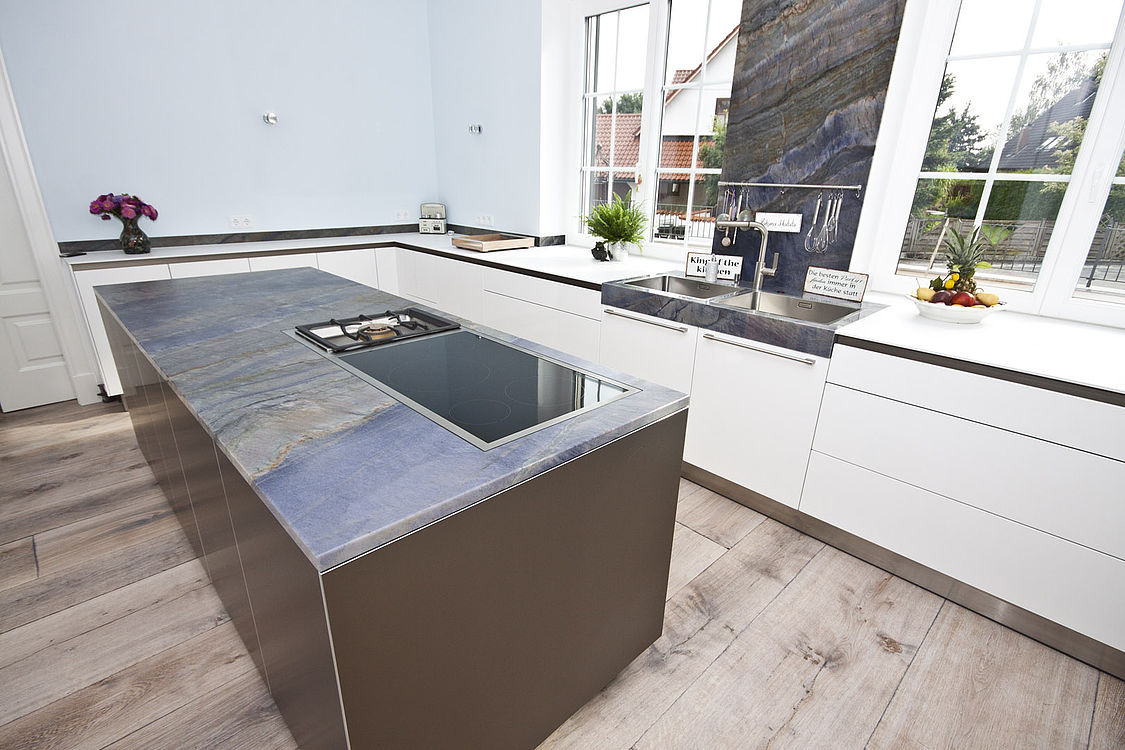
For kitchen worktops, Azul Imperial is well suited with careful maintenance: cut- and scratch-resistant (Mohs hardness 7), insensitive to heat (hot pots and pans can be set down directly for short periods, but prolonged heat exposure above 200 °C should still be avoided), acid-resistant and with high flexural strength for long slab overhangs. The expressive wave-band structure conceals small signs of use remarkably well. For intensively used professional kitchens we recommend alternative denser hard stones such as Mahogany India (water absorption 0.03 %); for a designer kitchen with a dramatic pastel blue material staging and deliberate care, however, Azul Imperial is an exceptional choice.

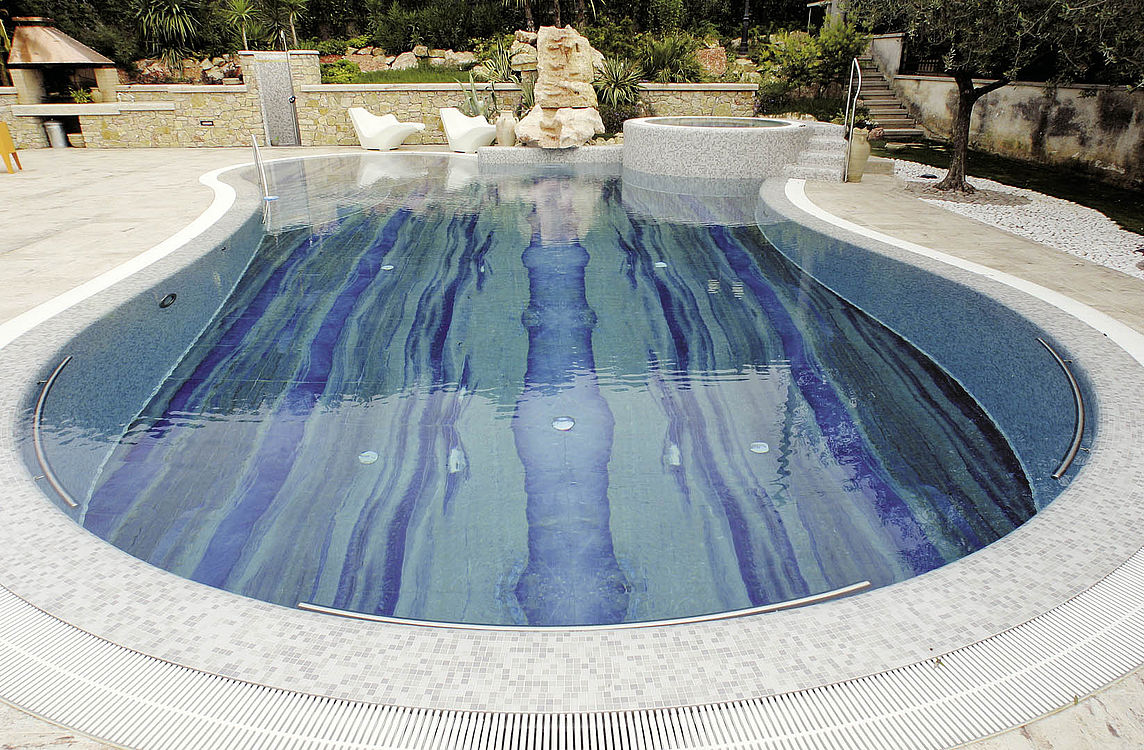
For external applications, Azul Imperial is suitable in principle given its DIN-confirmed frost resistance (10 % loss after frost) — before large-area external applications, however, we recommend a project-specific check of the data sheet with the importer and a particularly careful sealing strategy. Polished external surfaces can show loss of gloss after years in positions with heavy UV loading — and with dumortierite-bearing stones, minimal colour changes can occur under very long UV exposure over decades. For pool areas we always recommend satin-honed or textured surfaces for slip resistance. In areas with frequent salt contact (de-icing salt, pool chlorine) we recommend an additional refresh of the sealer every 6 months, because of the somewhat higher water absorption.

Frequently asked questions

Why is Azul Imperial blue?

The unique blue colouring of Azul Imperial derives from embedded dumortierite (Al7BO3(SiO4)3O3) — a rare aluminium boro-silicate mineral that is commercially quarried in only a few deposits worldwide. Unlike most other 'blue' natural stones, whose colour comes from cordierite, iolite or sodalite, the blue of Azul Imperial is genuinely based on a blue mineral — which makes the stone one of the rarest and most exclusive commercially available natural stones in the world.

What is Azul Imperial geologically?

Azul Imperial is a Mesoproterozoic (around 1.2 billion years old) metamorphic quartzite from the quarrying area south of the village of Oliveira dos Brejinhos in the state of Bahia in Brazil. The stone formed from an originally quartz-rich sandstone through high-pressure and high-temperature metamorphism. The blue colouring derives from embedded dumortierite. The main producer is SuperClássico in Bahia.

What synonyms are there?

In international trade, Azul Imperial also runs under the designations Imperial Blue Quartzite (the principal English name), Azul Imperiale (the Italian spelling variant), Imperial Sky Blue Quartzite and occasionally Brazilian Imperial Blue. All designations refer to the same Brazilian dumortierite-bearing quartzite from Bahia.

Which technical values does Azul Imperial have?

Exceptionally strong values for an exotic quartzite: bulk density 2,661 kg/m³, compressive strength 186.3 MPa, compressive strength after frost 168.7 MPa (10 % loss = good frost resistance), flexural strength 19.8 MPa (exceptionally high), water absorption 0.43 % (slightly elevated for a quartzite), abrasion resistance 0.47 mm (very good), Mohs hardness around 7. Full acid resistance as a silicate rock. The high flexural strength qualifies the stone for long slab overhangs on kitchen islands or bar counters.

Why is Azul Imperial so expensive?

Several factors make Azul Imperial one of the most expensive commercially available natural stones: 1) The rarity of the dumortierite occurrence — worldwide there are only a few quarries with this mineral composition. 2) The limited extraction capacity of the quarry south of Oliveira dos Brejinhos. 3) The high requirements placed on raw block quality (even blue distribution, clear band structure). 4) The international logistics costs from Bahia/Brazil to Europe. 5) The high demand in high-end design projects worldwide. An investment justified by the incomparable visual effect.

Is Azul Imperial suitable for bookmatch installation?

Excellently suited — bookmatching is in fact the typical way of staging this material. In bookmatch installation (two slabs laid as mirror images), the flowing, directional wave bands produce symmetrical, almost surreal large-scale motifs that read like reflecting water landscapes or frozen currents. A very fitting setting for prestige wall cladding, bar counters or designer statement surfaces in hotel lobbies, high-end restaurants and spas. A project-specific visual inspection is advisable when selecting slabs.

Is Azul Imperial suitable for a kitchen worktop?

Yes, well suited with careful maintenance. With a Mohs hardness of around 7, high compressive strength (186.3 MPa), exceptional flexural strength (19.8 MPa) and full acid resistance, Azul Imperial is cut-, scratch- and heat-resistant. The somewhat higher water absorption (0.43 %) compared with very dense quartzites calls for a more careful sealing strategy and quick reaction to spills of strongly pigmented substances such as red wine, tomato sauce or turmeric. Honest expectations: Azul Imperial is a designer statement stone, not a maintenance-free all-rounder. For intensive professional kitchens, dense dark hard stones such as Mahogany India are more practical.

Which finishes are available for Azul Imperial?

The finishes available from stock are listed in the »Finishes« block on this page.

Projects using Azul Imperial

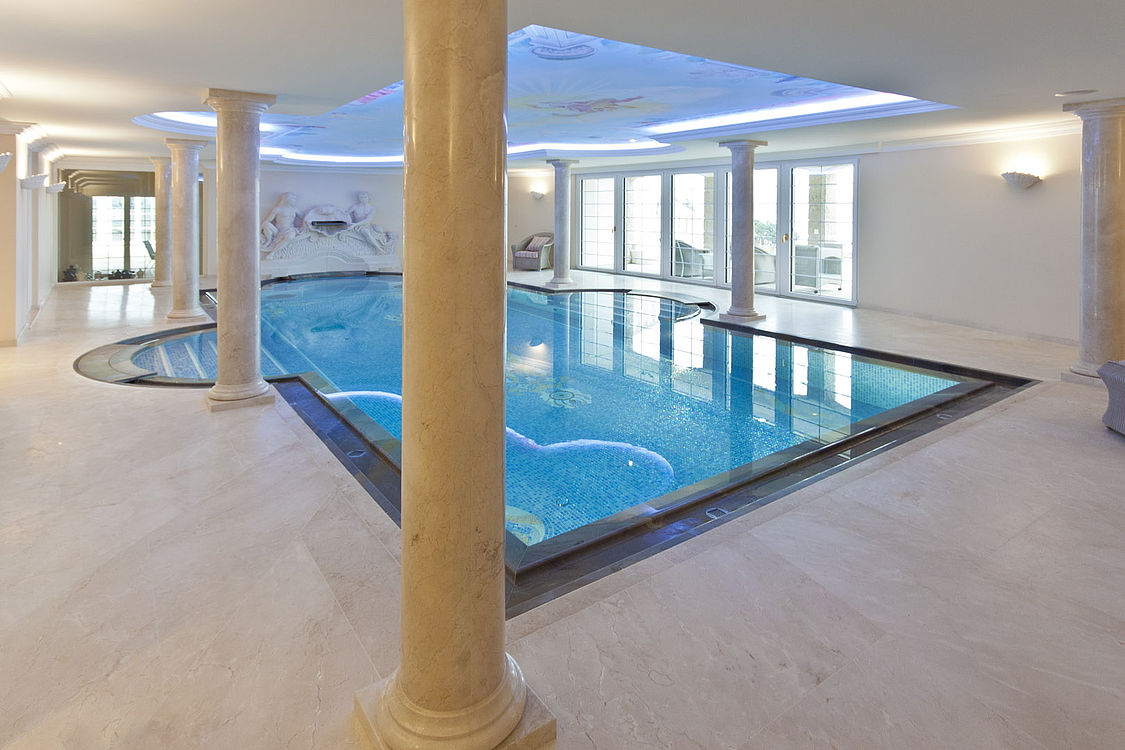
Projects in which Azul Imperial has been used successfully.

Azul Imperial Böden

Azul Imperial

Gouda Natuursteen (Peter Overkamp)

Azul Imperial Anderes

Azul Imperial

Seibold Naturstein

Azul Imperial Böden

Azul Imperial

Vetter Natursteinbetrieb

Azul Imperial Küchen

Azul Imperial

Hanel Natursteinmanufaktur

Azul Imperial Anderes

Azul Imperial

PROFORM Natursteintechnik

Azul Imperial Anderes

Azul Imperial

Check the live stock Request an appointment