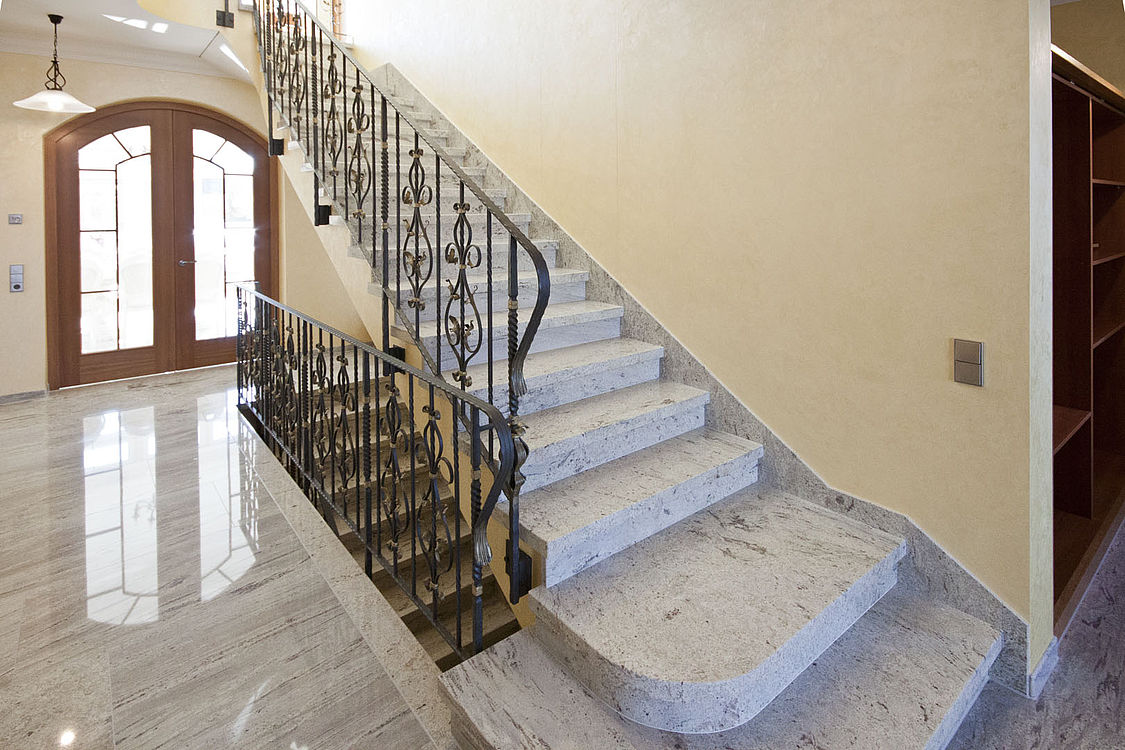
Background. Juparana Bianco is one of the best-known Brazilian “white” natural stone grades from the family of Juparana dimension stones. The trade name “Juparana” goes back to a tropical Brazilian tree whose flamed, clouded figure resembles the typical fluid banded structure of this stone family. The grade has been marketed internationally since the 1990s and is one of the classic Brazilian premium stones for kitchen worktops and prestige architectural applications.
Geology and occurrence. Petrographically, Juparana Bianco is a migmatite – a high-grade metamorphic mixed rock formed by partial anatexis (partial melting) of a pre-existing metamorphic parent rock under extreme pressure and temperature conditions deep in the earth's crust. In this high-temperature metamorphism the lighter mineral fractions (quartz, feldspar) melt selectively, while the darker mineral fractions (mica, garnet, pyroxene) remain in the solid state – after cooling, a characteristic mixed texture arises of pale, granitic-looking bands (leucosome) and darker, gneissic-looking bands (melanosome). The deposits of Juparana Bianco lie in the Precambrian shield of south-eastern Brazil, above all in the states of Espírito Santo and Bahia – the stone is shipped through the ports of Vitória and Rio de Janeiro.
Trade designation. In the international stone trade, Juparana Bianco is carried as a “Brazilian granite” – that is a commercial classification for all hard-crystalline, polishable plutonic rocks. Petrographically, however, the grade is a migmatite (not a granite in the narrower sense) – the more precise classification is granulite migmatite or quartz-feldspar migmatite. In practice this distinction is less relevant, because migmatites react mineralogically and mechanically like high-quality granites – with the same properties (acid-proof, hard, frost-resistant, polishable).
Appearance. The ground tone is a warm, creamy white dimension stone white to pale beige with fine warm golden and ochreous undertones – appearing markedly warmer and more natural than cool white granites or ice-white engineered quartz. Irregularly flowing, softly cloudy bands run across the surface with subtle grey, beige-grey and sometimes light brown tones, among which darker mineral clusters (grey mica concentrations, black biotite flakes, occasionally red-brown garnet grains) and isolated rust-brown iron oxide speckles are distributed. The movement of the banding is characteristically irregular and flowing rather than strictly linear – it recalls a slowly flowing stream with pale and darker channels running into one another. From a middle distance the grade appears lively, warm and creamy; up close one discovers the geological complexity with its fine mineral details.
Technical properties. Bulk density 2,560 kg/m³, compressive strength 150.9 MPa, flexural strength 12.4 MPa, water absorption 0.17 %, Mohs hardness about 6 – 7. The stone therefore lies technically in the more stable range of the granite and migmatite family and is structurally and mechanically suitable for all demanding applications. Frost-resistant, fully UV-stable and – as a silicate rock – almost entirely acid-proof (quartz, feldspar and mica do not react to acids such as vinegar, wine or lemon). Heat-resistant: hot pots can be set down directly for short periods.
ROSSITTIS range. The finishes available from stock are listed in the »Finishes« block further down this page. From the slabs we fabricate kitchen worktops, bar counters, islands, vanity tops, wall claddings, floor tiles in made-to-measure formats, stair treads and risers, window sills, skirtings, external floor coverings, pool surrounds, terrace slabs and façade elements.
Comparison. Within the Brazilian migmatite family, Juparana Bianco is one of the warmest, creamier and paler grades. Related migmatites are Juparana Colombo (lighter with golden-yellow accents), Juparana Persa (warm reddish with more powerful bands), Juparana Florence (cooler with grey bands) and Juparana Light (very pale, calmed). Compared with Kashmir White (an Indian migmatite), Juparana Bianco is warmer and has a characteristic fluid banding – Kashmir White is cooler and has darker mineral clusters in a dotted distribution. Compared with New Caledonia (a pale Indian granite), Juparana Bianco is considerably more animated with a pronounced flow texture. Among the pale Brazilian hard stones, related grades are Bianco Antico, Bianco Romano and Branco Itaúnas.
Honest assessment. Juparana Bianco is the optimal choice for any application calling for a warm, natural, pale natural stone effect with characteristic geological movement. The grade works particularly strongly as a kitchen worktop and island in warm kitchen concepts, as wall and floor covering in prestige living and hospitality spaces and as a façade element in Mediterranean, warm architectural concepts. Anyone looking for a calm, homogeneous material effect should reach for classically grained granites or engineered quartz; anyone wanting a cooler white natural stone appearance should switch to Kashmir White or Bianco Crystal; anyone wanting a more powerful geological banding with warm tones should reach for Juparana Persa or Colombo.