Granite from Italy

Rosa Beta

Rosa Beta is a Sardinian granite from the Gallura region with a grey-pink ground colour and an evenly granular texture. As one of the best-known Italian granites, it combines the warm colouring of Mediterranean architecture with the robustness of a plutonic rock.

Granite Italy Frostbeständig Säurebeständig 2.623 kg/m³
Available as: Slabs, Skirting, Paving slabs, Tiles and flooring slabs · 3 of 396 reserved

Other trade names: Beta Rosa Granite, NDG 026, Omegarose, Padang TG48 Rosa Beta, Pink Sardo Granite, Rosa Beta Chiaro Granite, Rosa Beta Granite, Rosa Limbara Granite, Rosa Sardegna Beta Granite, Rosa Sardo B Granite, Rosa Sardo Beta Granite, Rose Beta Granite, Sato

About Rosa Beta

Rosa Beta is a medium-grained granite – petrographically, more precisely a quartz monzonite – from the island of Sardinia, Italy. The stone is quarried in the Gallura region in north-eastern Sardinia, a landscape known for its granite outcrops and its millennia-old tradition of building in stone. The mineral composition of quartz, feldspar and mica produces the characteristic interplay of grey, pink and white.

Visually, Rosa Beta shows an evenly granular fabric with a grey-pink ground interspersed with white feldspar inclusions. The pink tone is restrained – more a warm grey with a hint of pink than a strong pink. This understated colouring makes the stone versatile in combination and gives it a timeless elegance that has been valued in European architecture for decades.

In stock

Current availability from our warehouse.

Technical data

Guide values for the stone type, taken from manufacturer and test reports. Natural stone is a natural product — individual batches and slabs can differ. For critical applications, request slab-specific test data.

Rohdichte 2.623 kg/m³
Druckfestigkeit 153,3 MPa
Biegezugfestigkeit 15,0 MPa
Wasseraufnahme 0,47 %
Frostbeständig Ja
Säurebeständig Ja

Suitability by application

Particularly suited to

Finishes

Rosa Beta is available in a range of finishes. The finish affects appearance, feel and the care it needs.

Poliert

Politur ist die klassischste Veredelung im Hartgesteinsegment — eine spiegelglatte, hochglänzende Oberfläche mit höchstmöglicher Farbintensität und maximaler Tiefenwirkung der Mineralstruktur. Als säurebeständiges Silikatgestein ist polierter Granit pflegeleicht und für Küchenarbeitsplatten, Wandverkleidungen und repräsentative Sichtflächen erste Wahl.

Satiniert

Die satinierte Oberfläche entsteht durch Bürsten, das weichere Minerale gezielt entfernt und der Fläche eine leichte Tiefe gibt. Mattes Erscheinungsbild mit subtiler Lichtreflexion und haptisch warmer Wirkung. Pflegeleicht, kratzunempfindlich und alltagstauglich — beliebte Alternative zur Politur in modernen Küchen und Wohnräumen.

Geschliffen C120

Mattes Erscheinungsbild durch groben Schliff mit Körnung C120 — die ebene Oberfläche zeigt eine zurückhaltendere Farbintensität als poliert und kann sichtbare Schleifspuren tragen. Im Vergleich zur Politur pflegeintensiver, aber stilistisch ruhiger; bevorzugte Wahl für moderne Innenarchitektur mit reduzierter Reflexion.

Sandgestrahlt+satiniert

Die Oberfläche wird sandgestrahlt aufgeraut und anschließend gebürstet — dadurch entsteht eine plane Fläche mit sanfterer Haptik als rein sandgestrahlt. Die Farbe wirkt zurückhaltend, die Textur ist rutschhemmend. Für anspruchsvolle Außenanwendungen, bei denen Trittsicherheit mit einer feineren Haptik kombiniert werden soll.

Geflammt + 1 x gebürstet

Die Oberfläche wird durch Hitze aufgeraut und einmal gebürstet, um scharfkantige Mineralreste zu glätten und loses Material zu entfernen. Etwas sanftere Haptik als rein geflammt, weiterhin rutschhemmend, Farbe weniger intensiv als poliert. Standardwahl für Außenbereiche, Terrassen und stark beanspruchte Bodenflächen.

Care & fabrication

As a granite, Rosa Beta is generally easy to look after. Sealing after installation is recommended in order to reduce the water absorption of 0.31 % further and to ensure stain resistance.

For daily cleaning, a pH-neutral natural stone cleaner with clear water is sufficient. Rosa Beta is chemically more robust than marble or limestone – mild all-purpose cleaners are generally compatible, but strongly acidic or strongly alkaline products should nevertheless be avoided.

On polished surfaces, use microfibre cloths and avoid abrasives. Refresh the sealer every 18–24 months. Outdoors, take care to install correctly with drainage mortar and remove moss growth regularly, as organic acids can attack the surface over time.

Frequently asked questions

Is Rosa Beta a true granite?

In the trade, Rosa Beta is sold as a granite. Petrographically it is more precisely a quartz monzonite, that is, a granite-related plutonic rock with a slightly different mineral composition. In practical use, Rosa Beta behaves like a classic granite: hard, dense and durable.

Is Rosa Beta suitable for kitchen worktops?

Yes, Rosa Beta is a solid choice for kitchen worktops. The compressive strength of 168.6 MPa and the low water absorption make it fit for everyday use. When designing larger overhangs structurally, the moderate flexural strength of 11.3 MPa should be taken into account.

Where does Rosa Beta granite come from?

Rosa Beta is quarried in the Gallura region in the north-east of the Italian island of Sardinia. Sardinia is among the most important granite suppliers in Italy and Europe.

Is Rosa Beta frost-resistant?

The technical data point to very good frost resistance: after frost exposure the residual compressive strength is 162.1 MPa compared with 168.6 MPa in the unexposed state – a drop of less than 4 %. Rosa Beta is therefore very well suited to external use.

Projects using Rosa Beta

Projects in which Rosa Beta has been used successfully.

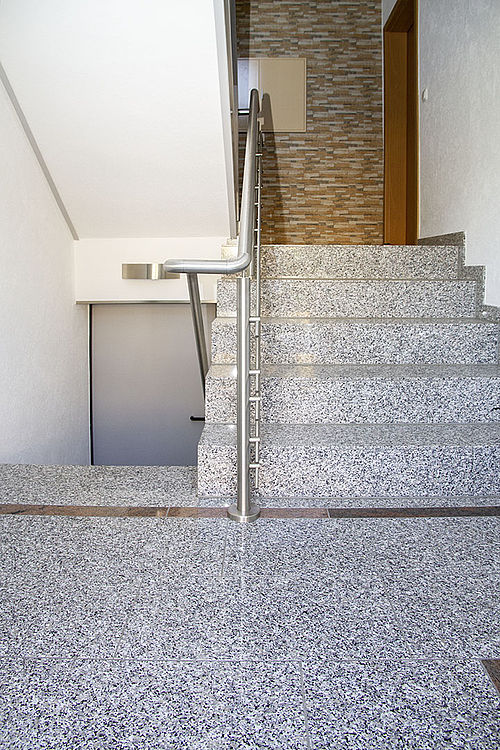
Rosa Beta / Multicolor Rot Treppen

Rosa Beta / Multicolor Rot

Burandt Natursteine

Check the live stock Request an appointment