
Granite from India

Sapphire Blue

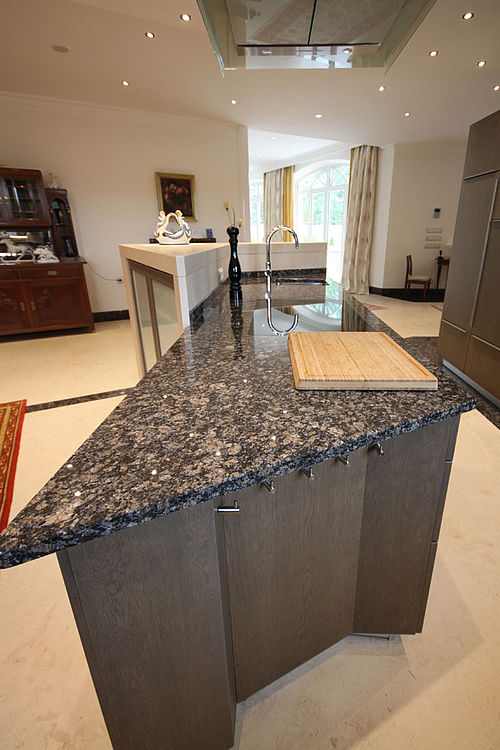
Sapphire Blue is an exceptional Precambrian Indian hard stone from Kasipet in the Warangal district in the state of Telangana — a metamorphic granite gneiss or granulite with a coarse-grained structure, a dark violet to anthracite-grey groundmass and characteristic subtle schiller reflections from the plagioclase crystals. The DNSA main name is Zephyr Blue (with the alias Sapphire Blue). Internationally also traded as Indian Sapphire Blue, Zephyr Blue Granite and Warangal Sapphire; used for statement wall claddings, bar counters, designer kitchen worktops, exterior façades, floor areas and prestige building applications with a dramatically dark material effect and a subtle schiller.

Petrographically, Sapphire Blue is a metamorphic granite gneiss or granulite from Kasipet/Warangal in Telangana, India — DNSA classifies the material as metamorphic with a foliated structure. In international trade the stone is traditionally listed as “granite”, because in fabrication and mechanical properties it is handled like a classical hard stone. At ROSSITTIS we classify Sapphire Blue in the granite family in line with trade usage, following the widely established trade convention for Indian metamorphic hard stones. DNSA principal name: Zephyr Blue (entry 3136).
Granite India Frostbeständig Säurebeständig 2.730 kg/m³
Available as: Slabs

Other trade names: Brown Sapphire, RO-01-477, Saphir Blue, Saphire Blue, Zephyr Blau, Zephyr Blue

About Sapphire Blue

Sapphire Blue shows an exceptionally characterful, darkly elegant Indian hard stone character with subtle blue and violet schiller reflections. The groundmass consists predominantly of dark violet to anthracite-grey areas with a coarse-grained metamorphic structure. Characteristic are the medium-sized plagioclase mineral crystals typical of Sapphire Blue, which create a subtle schiller effect — the slender plagioclase tablets reflect the light in different directions and, depending on the incidence of light, show shifting blue-violet-silvery reflections. Alongside them are black biotite mineral dots and pale bluish-grey quartz areas, which enliven the otherwise dark slab. The mineral structure is directional (foliated) — typical of metamorphic granite gneisses or granulites transformed by pressure and temperature metamorphism from an originally igneous plutonic rock. On a polished surface the stone develops a rich depth — the dark areas intensify, the plagioclase crystals unfold their subtle schiller reflections and the stone looks like a sapphire set in stone. The name 'Sapphire Blue' refers to the subtle blue reflections and the dark, sapphire-like groundmass — a very fitting trade designation.

In stock

Current availability from our warehouse.

69 slabs in stock · plus 3 blocks

Thicknesses: 2–4 cm · Finishes: Polished · Available as: Slabs

Updated daily from our live stock.

Technical data

Guide values for the stone type, taken from manufacturer and test reports. Natural stone is a natural product — individual batches and slabs can differ. For critical applications, request slab-specific test data.

Rohdichte 2.730 kg/m³
Druckfestigkeit 195,9 MPa
Biegezugfestigkeit 14,2 MPa
Wasseraufnahme 0,32 %
Frostbeständig Ja
Säurebeständig Ja

Suitability by application

Particularly suited to

Finishes

Sapphire Blue is available in a range of finishes. The finish affects appearance, feel and the care it needs.

Polished

Polishing is the most classic finish in the hard stone segment — a mirror-smooth, high-gloss surface with the highest possible colour intensity and maximum depth effect in the mineral structure. As an acid-resistant silicate stone, polished granite is easy to care for and the first choice for kitchen worktops, wall claddings and prestigious exposed surfaces.

Care & fabrication

As an Indian hard stone, Sapphire Blue is an exceptionally robust stone with low water absorption (0.32 %), full frost and acid resistance and very high compressive strength. Wine, lemon juice, vinegar, cola, sanitary cleaners or descalers leave no etch marks as they would on marble or limestone — the stone is considerably easier to look after and ideally suited to intensive everyday use.

For interior applications we recommend a silane- or polysiloxane-based impregnation at first installation. On polished surfaces a refresh every 8–10 years is enough; on heavily used kitchen worktops or in exterior applications, check every 3–5 years.

Day-to-day care is done with a pH-neutral natural stone cleaner and a soft cloth or microfibre mop. Clear warm water is usually enough. Acidic cleaners are in principle unproblematic, but should nevertheless not be used, because they can attack the impregnation. The surface finishes available from stock are listed in the »Finishes« block further down.

For kitchen worktops Sapphire Blue is outstandingly suited: cut- and scratch-resistant (Mohs hardness 6–7), insensitive to heat (hot pots and pans can be set down directly for short periods, but longer heat exposure above 200 °C should still be avoided), acid-resistant and with excellent stain repellency. The dark violet tone with its subtle schiller reflections gives designer kitchens an unmistakable visual character.

For exterior applications Sapphire Blue is particularly well qualified: the DNSA-confirmed durability of the polish outdoors (durable outdoors), the low water absorption (0.32 %) and the excellent frost resistance make the stone a first choice for demanding exterior façades with the polish retained. Polished exterior façades keep their brilliance and subtle schiller effect for years.

For pool surrounds, outdoor terraces and fountain enclosures, a slip-inhibiting textured finish is mandatory — on polished exterior surfaces there is a high risk of slipping when wet. In areas with frequent salt contact we recommend an additional impregnation refresh every 2–3 years.

Frequently asked questions

What is Sapphire Blue geologically?

Sapphire Blue is a Precambrian metamorphic hard stone from Kasipet in the Warangal district in the southern Indian state of Telangana. DNSA classifies the material as 'metamorphic' with a foliated structure, which points to a granite gneiss or granulite. The DNSA main name is Zephyr Blue (entry 3136). In international trade the stone is listed as a 'granite'; at ROSSITTIS we classify the material within the granite family in line with trade practice.

Which synonyms are there?

In international trade, Sapphire Blue also runs under the designations Zephyr Blue (the DNSA main name), Indian Sapphire Blue, Warangal Sapphire and Sapphire Blue Granite. The trade name 'Sapphire Blue' aptly describes the characteristic dark, sapphire-like groundmass with its subtle blue reflections.

Which technical values does Sapphire Blue have?

Exceptionally strong values: bulk density 2,730 kg/m³ (very high), compressive strength 195.9 MPa (very high), flexural strength 14.2 MPa, water absorption 0.32 %, linear thermal expansion 0.61 mm/m/100K, Mohs hardness 6–7. Full frost and acid resistance as a silicate rock. DNSA confirms a durable outdoor polish — the polished surface keeps its gloss outdoors for years.

What is the characteristic schiller effect?

Sapphire Blue shows subtle blue-violet-silvery schiller reflections from embedded plagioclase mineral crystals. The slender plagioclase tablets reflect the light in different directions — as the incidence of light changes, a restrained shifting effect emerges that gives the stone its 'sapphire' character. Related grades with a similar schiller effect are Steel Grey, Vizag Blue and Lavender Blue from the same southern Indian granite-gneiss complex.

Sapphire Blue or Vizag Blue?

Both come from the southern Indian granite-gneiss complex (Telangana/Andhra Pradesh) with similar schiller effects, but they differ in tone and intensity. Vizag Blue is markedly bluer with a more pronounced labradorescence effect — the more intense blue version. Sapphire Blue is a darker violet with subtler blue reflections — the balanced version with an elegant dark basic mood. For maximum blue intensity, Vizag Blue is the choice; for dramatically dark elegance with a subtle schiller, Sapphire Blue is the more coherent option.

Is Sapphire Blue suitable for a kitchen worktop?

Outstandingly suited. With Mohs hardness 6–7, low water absorption (0.32 %), very high compressive strength (195.9 MPa) and full acid resistance, the stone is cut-, scratch- and heat-resistant and does not absorb the acids in wine, lemon or vinegar. The dark violet tone with its subtle schiller reflections gives designer kitchens an unmistakable visual character.

Which surface finishes are available for Sapphire Blue?

The surface finishes available from stock are listed in the »Finishes« block on this page.

Is Sapphire Blue suitable for exterior façades?

Outstandingly suited — DNSA confirms a 'durable outdoor polish'. The polished surface keeps its gloss outdoors for years, which makes the stone a first choice for prestige exterior façades with the gloss and the subtle schiller effect retained. The low water absorption, the high compressive strength and the frost resistance qualify the stone for demanding exterior façades in heavily weather-exposed locations.

What does Sapphire Blue cost?

The price depends on the batch, thickness, surface finish and fabrication — with natural stone there is no serious flat rate per square metre. Business customers see prices once their B2B account is activated; private customers receive a complete quote through a fabricator near them.

Projects using Sapphire Blue

Projects in which Sapphire Blue has been used successfully.

Sapphire Blue Küchen

Sapphire Blue

Karl Faig GmbH

Check the live stock Request an appointment