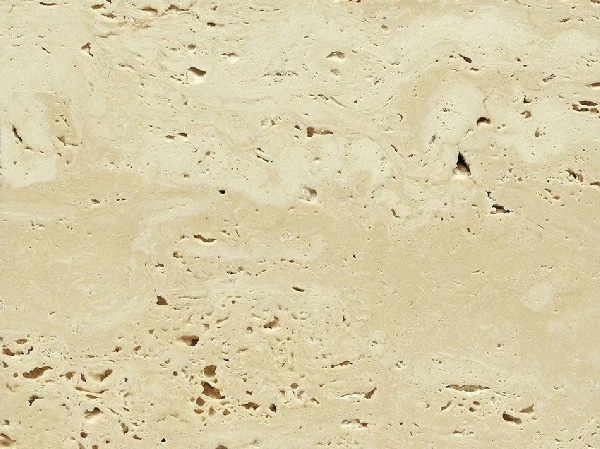
Travertin Chiaro (Italian “chiaro” for light) is the German collective designation for the pale Italian travertines — above all the classic Travertino Romano Chiaro from Bagni di Tivoli near Rome and the Travertino Piceno (Ascolano Chiaro) from Ascoli Piceno and Pescara. Characteristic are cream-beige to ivory-coloured grounds with the classic horizontal travertine bedding. Frost-resistant, acid-sensitive — used for wall claddings, floor areas, stairs, pool surrounds, facades and prestige Italian architecture in the Roman building tradition since antiquity.
Travertin Chiaro is a German collective designation covering essentially the Travertino Romano Chiaro from Bagni di Tivoli near Rome and the Travertino Piceno (Ascolano Chiaro) from Ascoli Piceno/Pescara. Both are Quaternary freshwater travertines of Italian origin with a characteristically light, cream-beige ground effect.
Other trade names: ACQUASANTA VENATO CHIARO, ASCOLANO CHIARO, TRAVERTINO NAVONA, TRAVERTINO PICENO, TRAVERTINO ROMANO CHIARO
About Travertin Chiaro
Travertin Chiaro brings together the palest and most widely used Italian travertine varieties under one German collective name. The unmistakable core of this family is the world-famous Travertino Romano Chiaro from the quarrying area around Bagni di Tivoli, roughly 30 kilometres east of Rome — the “stone of the Eternal City”, from which the Colosseum, the columns of St Peter's Basilica, the bridges over the Tiber and countless other buildings of ancient, medieval and modern Roman architecture were built. Alongside it, the collective designation covers the high-grade Travertino Piceno (also Ascolano Chiaro) from the provinces of Ascoli Piceno and Pescara in the Italian Adriatic region — a travertine variety whose visual character is close to that of the Romano Chiaro and which is frequently used in parallel with it on the Italian and European markets.
Geologically, the Italian Chiaro travertines are Quaternary freshwater travertines formed by the slow precipitation of calcium carbonate from supersaturated warm spring waters. In the Tivoli basin, hot sulphurous mineral springs built up massive travertine deposits several tens of metres thick over hundreds of thousands of years — this formation has been known since antiquity as “Lapis Tiburtinus”, from which, via the Italian “travertino”, the international term travertine developed. During the precipitation process, plant remains, trapped gases and micro-organisms created the typical elongated cavities and horizontal bedding that characterise every travertine and shape its unmistakable appearance.
Visually, Travertin Chiaro is defined by a warm, cream-beige to ivory-coloured ground with discreet horizontal bedding — the classic, calmly elegant character that has been typical of Roman prestige architecture since antiquity. Unlike the darker variants (Travertino Romano Scuro, Walnut, Noce), the pale Chiaro remains within the soft cream spectrum and gives rooms immediate atmospheric warmth without reading as cool or cold. The typical travertine cavity structure is visible — either as an unfilled, open-pored variant with an expressly rustic, characterful appearance, or as a filled, closed variant with a smooth, closed surface. Both variants are established and are chosen according to the design scheme and the application. The finishes currently available from stock are listed in the »Finishes« block further down this page.
Technically, Romano Chiaro and Ascolano Chiaro show the values typical of high-grade Italian travertines: bulk density between 2400 and 2440 kg/m³, compressive strength from 75 to 110 MPa depending on the variety, flexural strength between 11 and 14 MPa and water absorption of 1.8 to 2.0 %. These values qualify both varieties without restriction for internal and external applications — frost resistance is traditionally DNSA-certified for Italian travertines, and the material's performance over thousands of years in Roman buildings is impressive testimony to its long-term weathering stability. Like all carbonate rocks, Travertin Chiaro is acid-sensitive and reacts to citric acid, vinegar or acidic cleaners with matt etching.
In interior fit-out, Travertin Chiaro is a choice proven over centuries for classically Italian, Mediterranean and prestige architecture — from residential and commercial buildings through to sacred and public architecture in the Roman building tradition. Classic applications are floor areas in entrance halls and living spaces, wall claddings, stair treads, skirtings, window sills and bathrooms. The warm cream-beige tonality harmonises with timber fittings, Mediterranean furniture styles, brass and bronze accents as well as with clear white and muted earth tones. Outdoors it is used as facade cladding in Mediterranean and neoclassical architecture, as plinth slabs, stair treads, pool surrounds and fountain surrounds — its historic track record and warm Italian character make it a timeless classic. The finishes currently available from stock are listed in the »Finishes« block further down this page.
In stock
Current availability from our warehouse.
5 slabs in stock · plus 3 blocks
Thicknesses: 1 cm · Finishes: Unfilled + satin-honed · Available as: Skirting, Tiles and flooring slabs
Guide values for the stone type, taken from manufacturer and test reports. Natural stone is a natural product — individual batches and slabs can differ. For critical applications, request slab-specific test data.
Rohdichte
2.420 kg/m³
Druckfestigkeit
92,5 MPa
Biegezugfestigkeit
12,6 MPa
Wasseraufnahme
1,90 %
Frostbeständig
Ja
Säurebeständig
Nein
Finishes
Travertin Chiaro is available in a range of finishes. The finish affects appearance, feel and the care it needs.
Unfilled + satin-honed
The natural pores and cavities remain visible and unworked — a typical characteristic of travertine. The surface is brushed for a subtle depth and a matte effect. More care-intensive than filled, but with a fully natural appearance and a pronounced tactile quality — a characterful choice for wall cladding.
Care & fabrication
As a carbonate rock, Travertin Chiaro is acid-sensitive and requires care that takes this sensitivity into account. Indoors, use warm water with a pH-neutral stone cleaning product only — acidic household cleaners, vinegar, citric acid descalers or other acidic substances cause matt etched patches that can only be reversed by professional repolishing or regrinding. Take up spilt acidic liquids promptly with clear water. Professional sealing after installation and every 1 to 2 years thereafter is recommended indoors and obligatory outdoors — it reduces water absorption decisively, protects against freeze-thaw damage and mitigates the uptake of pigments (red wine, coffee, olive oil). With the unfilled variant, dirt collects over time in the natural pores, which lets the appearance age in a deliberately lively way — anyone wanting a consistently even appearance should choose the filled variant. With pool surrounds, alongside sealing, attention to chlorinated splash water is important: strong chlorine can cause local lightening, and care products insensitive to salt water are to be preferred. De-icing salt in winter is absolutely to be avoided on external travertine surfaces — chloride-free de-icers are the gentler alternative.
Frequently asked questions
What does Travertin Chiaro mean?
“Chiaro” is Italian for light. In the German and European stone trade, “Travertin Chiaro” denotes the pale, cream-beige to ivory-coloured Italian travertines — as distinct from the darker varieties (Travertino Romano Scuro, Walnut, Noce). The collective designation covers above all the classic Travertino Romano Chiaro from Bagni di Tivoli near Rome and the Travertino Piceno (Ascolano Chiaro) from Ascoli Piceno and Pescara.
What is the difference between Travertino Romano Chiaro and Travertino Ascolano Chiaro?
Both are pale Italian travertines and are frequently used in parallel in the stone trade. Travertino Romano Chiaro comes from Bagni di Tivoli near Rome — the historically most significant travertine in the world, from which the Colosseum, St Peter's Basilica and countless other Roman buildings were built. It has a compressive strength of about 110 MPa and water absorption of 2.0 %. Travertino Ascolano Chiaro comes from the provinces of Ascoli Piceno and Pescara in the Adriatic region and shows a comparable appearance with somewhat lower technical values (compressive strength 75 MPa, water absorption 1.8 %). The choice between the two is predominantly a question of stone availability and price; the visual effect is very similar.
Why is travertine called “travertine”?
The name travertine derives from the Latin “lapis Tiburtinus” — “the stone from Tibur”. Tibur was the ancient Roman name of the town of Tivoli east of Rome, in whose surroundings the famous travertine quarries of Bagni di Tivoli have lain since Roman antiquity. From “Tiburtinus”, by way of medieval Italian, came the word “travertino”, from which the international term travertine then emerged. The etymology underlines the central importance of the Tivoli region for the entire travertine tradition worldwide.
Is Travertin Chiaro suitable for external applications?
Yes, with consistent sealing. Italian travertines have been proven as weather-stable building stones since Roman antiquity — frost resistance is DNSA-certified, and the water absorption of 1.8 to 2.0 % calls for proper sealing. Travertin Chiaro is used for facade claddings, plinth slabs, stairs, pool surrounds, fountain surrounds and moderately weathered external surfaces. For trafficked external surfaces, a matt, textured finish should be chosen.
What is the difference between filled and unfilled travertine?
Travertine naturally has open pores, which during processing can either be filled with polyester resin (filled) or left open. Filled travertine shows a closed, smoother surface, is easier to look after and is frequently the first choice in contemporary internal applications with comfort requirements. Unfilled travertine keeps its rustic character with visible pores — it is a stylistic decision for Mediterranean, antiquing or historicist architectural schemes. Travertin Chiaro is supplied in both variants.
Is Travertin Chiaro suitable for kitchen worktops?
Possible, but as with all travertines, with reservations. Its acid sensitivity to lemon juice, vinegar, wine and cola, together with the open pore structure, makes the stone less suitable for intensively used family kitchens. Anyone who accepts the characterfully ageing travertine aspect with its natural patina formation as a design value gets a warm work surface that ages in a lively way; anyone wanting a stain-free surface should prefer acid-resistant hard rocks such as granite or quartzite, or a corresponding engineered quartz.
What does Travertin Chiaro cost?
The price depends on the batch, thickness, surface finish and fabrication — with natural stone there is no serious flat rate per square metre. Business customers see prices once their B2B account is activated; private customers receive a complete quote through a fabricator near them.