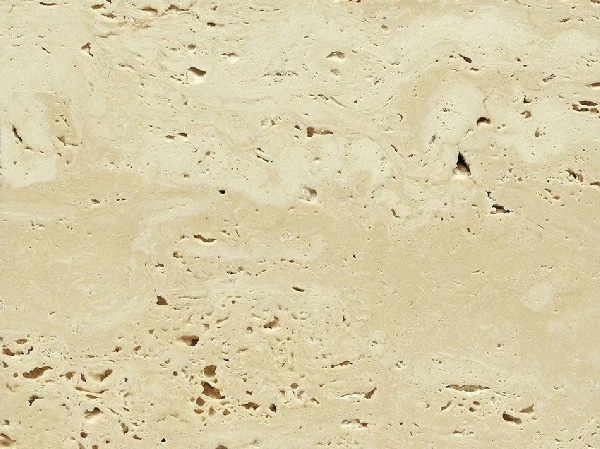
Travertin Romano Classico is a beige-cream Italian travertine with a cloudy or linear cut pattern. At ROSSITTIS we carry it for floors, wall cladding, stairs and classic interior and exterior architecture with a Roman feel.
Travertine
Italy
2.491 kg/m³
Available as: Slabs, Skirting, Tiles and flooring slabs ·
2 of 122 reserved
Other trade names: RO-03-001, Roman Classic Travertine, Römischer Travertin, Travertino Romano, Travertino Romano Classico, Travertino Venatello
About Travertin Romano Classico
Travertin Romano Classico is one of those stones that immediately trigger an architectural association. The material shows a light beige to hazelnut ground tone, together with the typical pores, banding and cut patterns of a genuine travertine. Depending on whether the stone is cut across the bed or along the vein, the surface appears more cloudy or more linear. It is precisely these two faces that make the stone so versatile: cross cut, softer and more classic; vein cut, more elongated and graphic. As a beige travertine, Romano Classico is a proven candidate for floors, wall cladding, stairs, bathrooms, window sills and Mediterranean-inflected outdoor spaces.
Its origin is in Italy, in the Tivoli area, that is, Lazio. Travertine is neither a marble nor a classic quarried limestone, but a chemically sedimentary stone formed from calcareous spring deposits. The visible pores are therefore not a fault but part of the geological character. For fabricators this matters, because depending on the finish and the intended use a decision has to be made as to whether the stone is worked open-pored, filled or closed. Compared with homogeneous limestone, travertine appears livelier; compared with marble, often somewhat earthier and more architectural.
The technical values fit this classification well: bulk density is 2,491 kg/m³, flexural strength 11.7 MPa and water absorption 0.6 %. The abrasion value is given as 21.3 mm. After freeze-thaw exposure, flexural strength still stands at 11.2 MPa. This is not an ultra-dense hard stone, but a cleanly documented travertine with a sound profile for architectural projects. What is decisive is that water absorption, pore pattern and finish are allowed for in the construction — then the material performs convincingly indoors and out.
The surface finishes currently held in stock are listed in the »Finishes« block further down. With travertine in particular, finish and format are closely bound up with one another. At ROSSITTIS, Travertin Romano Classico is available as an unsized slab, in tiles, as tread and riser, window sill, skirting, wall panel and as pool coping. As an alternative to Crema Marfil, Travertin Romano Classico appears more porous and livelier; as an alternative to Jura limestone, usually more homogeneous in colour and more strongly defined by the pore pattern.
The honest assessment: Travertin Romano Classico lives on its naturalness, but demands deliberate planning. Anyone looking for absolutely closed, chemically wholly relaxed surfaces is better served by granite, quartzite or ceramic. Anyone who wants a classic Italian travertine with genuine material depth gets one of the archetypal stones of European architectural history here — provided that finish, pore treatment and installation situation are not left to chance.
In stock
Current availability from our warehouse.
122 slabs in stock — 120 available now, 2 reserved · plus 38 blocks
Thicknesses: 1–3 cm · Finishes: Filled + polished, Filled + honed, Unfilled + polished and more · Available as: Slabs, Skirting, Tiles and flooring slabs
Guide values for the stone type, taken from manufacturer and test reports. Natural stone is a natural product — individual batches and slabs can differ. For critical applications, request slab-specific test data.
Travertin Romano Classico is available in a range of finishes. The finish affects appearance, feel and the care it needs.
Filled + polished
Natural pores and cavities are filled with a special filler compound and thus closed — the surface is then polished. The highest possible colour intensity and gloss; depending on the mineral composition, the material can at most be polished to a semi-gloss. Easier to care for than the unfilled variant.
Filled + honed
Natural pores and cavities are filled and closed with a special filler compound, after which the surface is finely honed. A matte appearance with a level, calm look; the finer the honing, the more intense the colour. Easier to maintain than unfilled, while remaining stylistically calm and elegant.
Unfilled + polished
The natural pores and cavities remain visible and unworked — a typical travertine characteristic. The surface is polished for the highest possible colour intensity and gloss; depending on the minerals, only satin-gloss may be achievable. More maintenance-intensive than filled, but with the full natural appeal.
Unfilled + honed
The natural pores and cavities stay visible and untreated — a typical characteristic of travertine. The surface is finely honed for a matt, level appearance; the finer the honing, the more intense the colour. More maintenance-intensive than the filled version, with an original, natural character.
Care & fabrication
Depending on the finish and the pore pattern, Travertin Romano Classico should be sealed carefully. Open-pored or only lightly filled surfaces in particular take up water and dirt more readily than a dense hard stone.
For cleaning and maintenance, pH-neutral natural stone cleaners, soft cloths and regular, mild routine cleaning are suitable. On filled surfaces it makes sense not to use aggressive products, so that fillings and stone surface are not unnecessarily stressed.
Avoid acidic cleaners, vinegar, bathroom cleaners, cement haze removers and strongly alkaline products. In the kitchen and bathroom, oil, coffee, wine or lemon juice should be taken up promptly, because as a calcareous stone travertine can react sensitively.
For external areas: frost must be allowed for in the construction, even though the material has been frost-tested. Ensure good drainage, no standing water and a finish that suits the use and the slip resistance required.
Frequently asked questions
Is Travertin Romano Classico suitable for a kitchen?
Yes, but with qualifications. Water absorption is 0.6 %, flexural strength 11.7 MPa – that is respectable for travertine. Since the material is calcareous and porous, a kitchen worktop should be well sealed and used with awareness in everyday life.
Which finishes are available for Travertin Romano Classico?
The surface finishes currently held in stock are listed in the »Finishes« block on this page.
Where does Travertin Romano Classico come from?
The stone comes from Italy, from the Tivoli area, that is, Lazio. It belongs to the classic Roman travertine tradition and is one of the best-known Italian architectural stones of all.
How do I clean Travertin Romano Classico correctly?
For cleaning and maintenance, use pH-neutral natural stone cleaners and no acidic products. Travertine should not be treated with vinegar, bathroom cleaner or limescale-dissolving agents, because the surface and any pore fillings can be damaged.
Is Travertin Romano Classico frost-resistant?
The sources cite a freeze-thaw test; after exposure, flexural strength still stands at 11.2 MPa. That points to usable external suitability, provided construction, drainage and choice of finish are properly resolved.
Travertin Romano Classico or Crema Marfil – which is better?
Crema Marfil appears more homogeneous and more closed, Travertin Romano Classico more porous and architecturally livelier. If you want a Roman-Mediterranean natural stone character, travertine is the better choice; if you are looking for a quieter beige surface, Crema Marfil is.
What does Travertin Romano Classico cost?
The price depends on the batch, thickness, surface finish and fabrication — with natural stone there is no serious flat rate per square metre. Business customers see prices once their B2B account is activated; private customers receive a complete quote through a fabricator near them.