Travertine from Italy

Travertin Navona

Travertin Navona is the pale, evenly creamy ivory grade of the classic Travertino Romano (also Travertino Romano Chiaro) from the Bagni di Tivoli quarry district in the province of Rome — the famous Roman travertine used since antiquity, among other buildings in the Colosseum. A Quaternary freshwater sedimentary limestone with a warm creamy beige tone and a very fine directional band structure (vein cut), filled for an entirely smooth slab appearance. Also traded internationally as Travertino Navona, Travertino Romano Chiaro and Tivoli Light; used for classically elegant interior wall cladding, bookmatch bar counters, bathrooms, prestige living spaces and Mediterranean interiors with a warm feel.

Travertine Italy Frostbeständig 2.440 kg/m³
Available as: Slabs, Skirting, Tiles and flooring slabs

Other trade names: In China Stone Market:象牙洞石(Xiàngyá Dòng Shí), Navona Travertine, Remo, Roma Navona Weiß, Travertin Clair, Travertine Navona, Travertino Navone, Travertino Romano Navona

About Travertin Navona

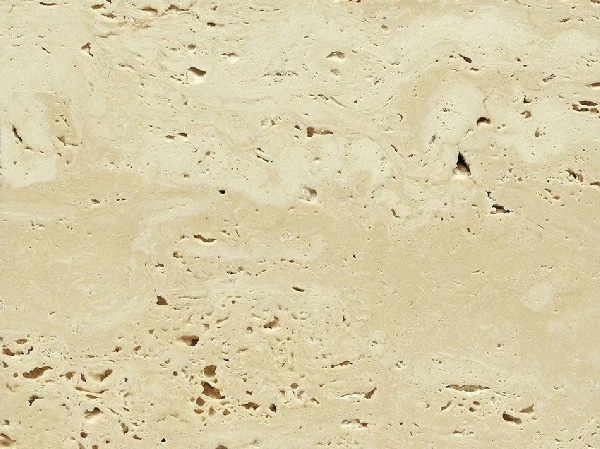
Travertin Navona shows an exceptionally classic, elegant Italian travertine character with the palest tone of the Travertino Romano family. The ground mass is a warm creamy ivory to light beige calcite matrix with the fine, directional layered band structure characteristic of travertines (vein cut, longitudinal section). The slab pattern shows subtle horizontal banding in various creamy tones — some bands denser and more even, others with fine, coin-sized pore accents. The standard supply, filled, presents entirely smooth surfaces — the natural travertine pores are filled with a colour-matched limestone mortar for an elegant, closed slab appearance. The designation 'Navona' refers to the famous Roman Piazza Navona — a marketing brand registration used in the German and Italian markets in parallel with the actual designation 'Travertino Romano Chiaro'. DNSA lists 'Navona' explicitly as an alias designation for this travertine type. The surface finishes currently held in stock are listed in the »Finishes« block further down.

In stock

Current availability from our warehouse.

Technical data

Guide values for the stone type, taken from manufacturer and test reports. Natural stone is a natural product — individual batches and slabs can differ. For critical applications, request slab-specific test data.

Rohdichte 2.440 kg/m³
Druckfestigkeit 110,0 MPa
Biegezugfestigkeit 13,3 MPa
Wasseraufnahme 2,00 %
Frostbeständig Ja
Säurebeständig Nein

Suitability by application

Suitable with limitations

Finishes

Travertin Navona is available in a range of finishes. The finish affects appearance, feel and the care it needs.

Gespachtelt+poliert

Natürliche Poren und Hohlräume werden mit einer speziellen Spachtelmasse gefüllt und somit verschlossen — anschließend wird die Oberfläche poliert. Höchstmögliche Farbintensität und Glanz; je nach mineralischer Zusammensetzung kann das Material maximal mattglänzend poliert werden. Pflegeleichter als die ungespachtelte Variante.

Gespachtelt+geschliffen

Natürliche Poren und Hohlräume werden mit einer speziellen Spachtelmasse gefüllt und verschlossen, anschließend wird die Oberfläche fein geschliffen. Mattes Erscheinungsbild mit ebener, ruhiger Anmutung; je feiner der Schliff, desto farbintensiver. Pflegeleichter als ungespachtelt, dabei stilistisch ruhig und elegant.

Care & fabrication

As an Italian freshwater sedimentary limestone, Travertin Navona is acid-sensitive. With a Mohs hardness of 4.5–5, medium water absorption (markedly lower when filled than the 2.0 % unfilled) and pronounced acid reactivity, the stone requires deliberate care and consistent sealing. These points should be deliberately taken into account in the choice of material — Travertin Navona is a deliberately chosen design material with a classic Italian feel, not a maintenance-free all-rounder.

For interior applications we recommend careful silane- or polysiloxane-based sealing at first installation. On polished surfaces we recommend refreshing every 1–2 years, and checking every 6–12 months in heavily used areas. This markedly more frequent refreshing than with hard stones is typical of travertine and marble.

Daily care is carried out with a pH-neutral natural stone cleaner and a soft cloth or microfibre mop. Clear warm water is usually sufficient. Acidic cleaners (vinegar, citric acid, bathroom cleaners, descalers) are to be STRICTLY avoided — they attack the travertine immediately and leave dull etch marks that can only be removed by professional re-honing. Cola, wine, tomato sauce and citrus fruits can also leave etch marks on untreated surfaces — blot spills immediately with a dry cloth.

For kitchen worktops, Travertin Navona is suitable only with qualifications — it is not fully acid-resistant and not fully cut- and scratch-resistant (Mohs hardness 4.5–5 versus 7+ for granite/quartzite). Heat resistance is given, but hot pans should not be set down directly (use trivets). For intensively used professional kitchens we recommend alternative hard stones. For an elegant designer kitchen with a classic Italian feel and careful maintenance, however, Travertin Navona can be very coherent — particularly for Mediterranean or classic schemes with a deliberate acceptance of patina.

The surface finishes currently held in stock are listed in the »Finishes« block further down. Acids or acidic cleaning products lead to visible dull etch marks particularly quickly on a polished surface — take the utmost care with bar counters in restaurants or bars.

The filled pores remain largely stable over the years, but under mechanical load can show small chips at individual fill points — these can be professionally re-filled and are not a material defect. For barefoot applications such as bathrooms, filled and honed is the more hygienic choice.

For external applications, Travertin Navona with a filled surface is NOT recommended — DNSA classifies polished external stability as non-durable. UV exposure and weathering lead over the years to visible loss of gloss. For external applications, unfilled travertine surfaces (with open pores) are rich in tradition; Travertin Navona as a filled variant is, however, explicitly optimised for interior applications.

Frequently asked questions

What is Travertin Navona geologically?

Travertin Navona is a Quaternary freshwater sedimentary travertine (limestone) from the Bagni di Tivoli quarry district east of Rome in the Italian region of Lazio. Travertines formed from hot springs in which dissolved calcium carbonate precipitated as calcite as pressure fell — the characteristic travertine pores derive from trapped gas bubbles. Bagni di Tivoli has been the main production region for Travertino Romano since Roman antiquity. Petrographically a freshwater sedimentary limestone.

What does 'Navona' mean?

The designation 'Navona' is a brand name for the pale grade of Travertino Romano — a trade designation used in parallel with 'Travertino Romano Chiaro' (Italian: pale Roman travertine). The name historically refers most likely to the famous Piazza Navona in Rome, one of the iconic building ensembles that contain Travertino Romano. DNSA lists 'Navona' explicitly as an alias for this travertine type.

What synonyms are there?

In international trade, Travertin Navona also runs under the designations Travertino Navona (Italian spelling variant), Travertino Romano Chiaro (the main Italian designation), Tivoli Light, Roman Travertine Light and occasionally Bagni Travertine. All designations refer to the pale grade of the classic Travertino Romano from Bagni di Tivoli.

Which Travertino Romano grades are there?

The Travertino Romano family comprises several grades by tone: Travertin Navona / Travertino Romano Chiaro (pale creamy ivory tone — the palest classic variant), Travertin Beige / Travertino Romano Classico (medium beige-honey tone — the most widely used standard variant), Travertino Noce (markedly darker, browner tone) and Travertino Silver (silver-grey). All come from the same quarries near Bagni di Tivoli, but differ in the iron oxide colouring of the sedimentary layers.

What technical values does Travertin Navona have?

Typical values for the pale Travertino Romano grade: bulk density 2,440 kg/m³, water absorption 2.0 % unfilled (markedly lower when filled), Mohs hardness 4.5–5. Important: as a limestone, travertine is acid-sensitive — wine, lemon juice, vinegar or bathroom cleaners leave immediate etch marks. Polished external stability is not durable.

What is the difference between filled and unfilled?

Travertine naturally contains characteristic pores — small voids from its original formation in hot springs. When 'filled', these pores are filled with a colour-matched limestone mortar before final finishing — the slab is then entirely smooth. When 'unfilled', the pores remain openly visible as an authentic stylistic element. At ROSSITTIS, Travertin Navona is carried in the more elegant filled variant — easier to maintain and more practical for bathrooms or bar counters.

Is Travertin Navona suitable for a kitchen worktop?

Suitable with qualifications, and with clear limitations. At a Mohs hardness of 4.5–5, travertine is markedly more sensitive than granite or quartzite — it is not fully cut- and scratch-resistant and it is acid-sensitive. Wine, lemon juice or vinegar leave immediate etch marks. For intensively used professional kitchens we recommend alternative hard stones. For an elegant designer kitchen with a classic Italian feel and careful maintenance, however, Travertin Navona can be very coherent — particularly for Mediterranean schemes.

Is Travertin Navona suitable for external use?

With a filled surface, not recommended — DNSA classifies polished external stability as non-durable. UV exposure and weathering lead over the years to visible loss of gloss. For external applications with a look similar to Travertin Navona, unfilled travertine surfaces with open pores are rich in tradition (see Travertin Beige C-C unfilled); Travertin Navona as a filled variant is, however, explicitly optimised at ROSSITTIS for interior applications.

Check the live stock Request an appointment