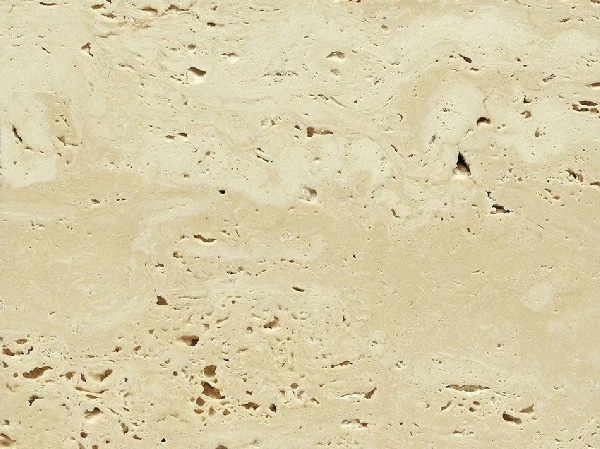
Travertin Striato (Italian “striato” for striped) is a classical Italian travertine from the quarry regions of Tivoli and Guidonia near Rome, rich in tradition — sawn as a vein cut, parallel to the sediment bedding, for maximum linear emphasis of the banding. The warm cream-beige ground with its pronounced horizontal stripe structure is the most expressive cut variant of the Roman travertine family. Frost-resistant, acid-sensitive — used for wall claddings, floor surfaces, staircases, façade claddings, pool surrounds and prestige internal and external architecture with an expressive, linear, architectural material signature.
Travertin Striato is the cut variant of the classical Italian travertine from the quarry regions of Tivoli and Guidonia near Rome, sawn as a vein cut (parallel to the sediment bedding). The linearly striped appearance arises from the cutting direction — geologically it is the same Quaternary freshwater travertine as Travertino Romano.
Travertin Striato is the expressively linear-patterned cut variant of the classical Italian travertine from the Roman quarry regions of Tivoli and Guidonia, rich in tradition. The designation “striato” (Italian for striped) refers to the cutting direction of the slabs: in contrast to the “cross cut” (cut across the bedding, giving a mottled, flowing image), the Striato is sawn as a “vein cut” — that is, along the original sediment bedding of the travertine, which brings out the natural horizontal banding in the form of clearly parallel lines and stripes. This type of cut brings the geological bedding structure of the travertine to bear with maximum expression and creates an architecturally rigorous, almost wallpaper-like directional slab image that has proved itself equally in modern contemporary architecture and in the classical Mediterranean building tradition.
Geologically it is the same Quaternary freshwater travertine as Travertino Romano Chiaro — formed by the precipitation of calcium carbonate from supersaturated warm mineral springs in the basin of Tivoli east of Rome. During the process of precipitation, plant remains, enclosed gases and micro-organisms produced the typical elongated voids and layered beddings that become visible in the vein cut as strikingly horizontal linear structures. The ancient Roman name “Lapis Tiburtinus” — the stone from Tibur (Tivoli) — refers to the travertine deposits in this region, in continuous use since Roman antiquity, from which the Colosseum, the columns of St Peter's Basilica and countless further buildings of Roman architecture were erected.
Visually, Travertin Striato is marked by a warm cream-beige to ivory-coloured ground effect, rhythmically articulated by clearly parallel horizontal stripes, bands and linear structures. The stripes vary in width and intensity: individual bands emerge as fine, almost line-like markings, others as broader, more softly contoured layers with visible void zones and widenings. This rhythmic articulation lends the stone an architecturally rigorous, directional quality that unfolds particularly well in modern, clearly composed interiors. The void structure typical of travertine is visible — either as an unfilled, open-pored variant with an expressly rustic, characterful quality or as a filled variant with a smooth, closed surface. The finishes currently available from stock are listed in the »Finishes« block further down this page.
Technically, Travertin Striato shows the values typical of high-quality Roman travertines: bulk density around 2,455 kg/m³, compressive strength of 109 MPa, flexural strength of 14.4 MPa and water absorption of 1.4 %. These values qualify it without restriction for internal and external applications — frost resistance is traditionally proven for Italian travertines, and the material's endurance over millennia in Roman buildings testifies impressively to its long-term weather stability. Like all carbonate rocks, Travertin Striato is acid-sensitive and reacts to citric acid, vinegar or acidic cleaners with matt etching. The low water absorption compared with some other travertines (1.4 % against 2.0 % for Romano Chiaro) is attributable to the somewhat higher material density and to the structural orientation of the vein cut.
In interior fit-out, Travertin Striato is a preferred choice for modern, contemporary-classical and prestige architecture in which the linear, rhythmic material signature is to be used architecturally. Classical applications are large-area wall claddings with horizontal vein alignment — the stripes form a continuous, almost wallpaper-like structure that visually widens the room and creates a classically elegant atmosphere. Further applications are floor surfaces in entrance halls and living spaces, stair treads, skirtings, window sills, bar counters and bathrooms. With bookmatched installation — mirror-image laying of adjacent slabs — particularly impressive symmetrical large-scale patterns arise from the linearly striped slabs, which have an imposing effect in prestige lobbies and accent walls. Outdoors it finds use as façade cladding, plinth panels, stair treads and pool surrounds — the warm cream tonality is impressive under southern light and harmonises with Mediterranean vegetation and architecture.
In stock
Current availability from our warehouse.
6 slabs in stock · plus 4 blocks
Thicknesses: 1 & 6.1 cm · Finishes: Filled + polished, Filled + honed · Available as: Slabs, Skirting
Guide values for the stone type, taken from manufacturer and test reports. Natural stone is a natural product — individual batches and slabs can differ. For critical applications, request slab-specific test data.
Travertin Striato is available in a range of finishes. The finish affects appearance, feel and the care it needs.
Filled + polished
Natural pores and cavities are filled with a special filler compound and thus closed — the surface is then polished. The highest possible colour intensity and gloss; depending on the mineral composition, the material can at most be polished to a semi-gloss. Easier to care for than the unfilled variant.
Filled + honed
Natural pores and cavities are filled and closed with a special filler compound, after which the surface is finely honed. A matte appearance with a level, calm look; the finer the honing, the more intense the colour. Easier to maintain than unfilled, while remaining stylistically calm and elegant.
Care & fabrication
As a carbonate rock, Travertin Striato is acid-sensitive and requires correspondingly adapted care. Indoors, use exclusively warm water with a pH-neutral stone cleaning agent — acidic household cleaners, vinegar, citric-acid descalers or other acidic substances cause matt etched patches that can only be reversed by professional re-polishing or regrinding. Take up spilled acidic liquids promptly with clear water. A professional sealing treatment after installation and again every 1 to 2 years is recommended indoors and obligatory outdoors — it further reduces the water absorption of 1.4 %, protects against freeze-thaw damage and mitigates the absorption of pigments (red wine, coffee, olive oil). With the unfilled variant, dirt collects over time in the natural pores, which deliberately allows the appearance to age vividly — anyone who wants a consistently even appearance should choose the filled variant. On pool surrounds, alongside the sealing treatment, attention to chlorinated splash water is important: strong chlorine can cause local lightening. Road salt in winter is to be avoided on external travertine surfaces — chloride-free de-icing agents are the gentler alternative.
Frequently asked questions
What does Travertin Striato mean?
“Striato” is Italian for striped and denotes the cutting direction of the travertine slabs parallel to the original sediment bedding — also called “vein cut”. This type of cut brings out the natural horizontal banding of the travertine with maximum expression and creates a clearly directional, linearly striped slab image. In contrast to the “cross cut” (cut across the bedding, giving a cloudy, mottled image without linear structures), the Striato shows the geological bedding structure of the stone as an architectural design language.
What is the difference between Travertin Striato and Travertin Chiaro?
Both come from the same Roman travertine family from Tivoli and Guidonia near Rome — the same material, a different cutting direction. Travertin Chiaro typically comprises cross-cut slabs with a calm, mottled image without pronounced linear structures. Travertin Striato is sawn as a vein cut and shows the parallel horizontal stripes of the sediment bedding. The choice between the two is a design decision — Chiaro for a calm, planar appearance, Striato for an architecturally rhythmic, directional material signature.
Is Travertin Striato suitable for wall claddings?
Outstandingly so. Because of its pronounced linear veining, Travertin Striato is particularly effective as a large-area wall cladding in prestige interiors — the parallel stripes create a continuous, almost wallpaper-like structure that can visually widen the room and generate a classically elegant atmosphere. With bookmatched installation (mirror-image laying of adjacent slabs), particularly impressive symmetrical large-scale patterns arise. Classical applications are hotel lobbies, entrance areas, bar counter back walls, bathroom accent walls and prestige living room accent walls.
Is Travertin Striato suitable for external use?
Yes, with consistent sealing. The low water absorption of 1.4 % and the high compressive strength of 109 MPa qualify Travertin Striato for façade claddings, plinth panels, stairs under a canopy, pool surrounds and moderately weathered external surfaces. With proper fabrication, the stone is weather-stable over decades in central European climatic conditions. For heavily weathered horizontal external surfaces, a matt, textured finish is to be chosen.
What is the difference between filled and unfilled Travertin Striato?
By its nature travertine has open pores, which in Travertin Striato become visible in the vein cut as longitudinally oriented voids and widenings. In the filled variant these pores are filled with transparent polyester resin, producing a closed, smooth surface — the linear stripes emerge clearly even without open pores. In the unfilled variant the voids remain visible, which underlines the rustic character and emphasises the structural depth of the stone. The choice is a matter of style.
Which slab formats are usual in Travertin Striato?
Standard large formats from the Roman travertine quarries lie typically between 250 × 130 cm and 300 × 160 cm at thicknesses of 2 cm and 3 cm. Through ROSSITTIS, thinner formats (1 cm for lightweight wall claddings) as well as skirtings and tile formats can also be sourced. Crust slabs in thicknesses of 6 cm and more are likewise available. When choosing slabs for bookmatched applications, prior slab sampling is recommended in order to match the courses of the bands to one another optimally.
What does Travertin Striato cost?
The price depends on the batch, thickness, surface finish and fabrication — with natural stone there is no serious flat rate per square metre. Business customers see prices once their B2B account is activated; private customers receive a complete quote through a fabricator near them.