Agglomerated stone binds real fragments of natural stone (marble, granite, quartz) with resin or cement into an industrially produced surface material. The natural stone content is 90–95 %, the binder 5–10 %.
Two families: resin-bound agglomerates are dense, non-porous and easy to care for — the modern choice for interior fit-out. Cement-bound terrazzo slabs are harder and more heat-resistant, but porous and in need of impregnation — the classic choice for prestigious floors.
The ROSSITTIS range holds CTX BasicAgglo (our own brand), EUVAL terrazzo and other Italian premium agglomerates — filter by colour and design.
 1242 slabs
CTX BasicAgglo® Micro Sivec
 1237 slabs
CTX BasicAgglo® New Micro Sivec
 938 slabs
CTX BasicAgglo® New Micro Carrara
 200 slabs
CTX BasicAgglo® New Hadrian
 154 slabs
CTX BasicAgglo® Micro Cement Grey
 138 slabs
CTX BasicAgglo® Royal Beige
 80 slabs
Description to follow
80 slabs
Description to follow
CTX BasicAgglo® Belgio C
 74 slabs
Bianco (Micro) Carrara Agglo IT
 61 slabs
Beige Marfil Agglo IT
 59 slabs
Botticino Agglo IT
CTX BasicAgglo® Micro Dark Grey
 50 slabs
Description to follow
50 slabs
Description to follow
Perlato Royal Agglo IT
The agglomerated stone lines in the ROSSITTIS range — from the value-priced own brand to Italian premium terrazzo.
The ROSSITTIS own brand
CTX BasicAgglo is our own brand for inexpensive, everyday-capable agglomerated stone. Six decors – from light Carrara and Sivec tones through creamy beige variants to the travertine-like Hadrian line – cover the most frequent requirements in interior fit-out. Particularly popular for window sills, stairs, washstands and low-maintenance interior surfaces with high consistency across the area.
Italian terrazzo
EUVAL (EurAgglo s.r.l.) is an Italian specialist in terrazzo slabs with characteristically large natural stone fragments on a light or dark ground. The EUVAL series brings classic Italian terrazzo in controlled industrial quality – ideal for prestigious floors, stairs and wall surfaces in residential and commercial properties.
Marble and onyx looks from Italy
Premium agglomerated stone of Italian manufacture – with marble chippings from Carrara, Sivec, Beige Marfil and Oniciato Belmonte looks. This line reproduces classic natural stone aesthetics with industrially uniform processing and reliable batch consistency. For interiors in which a calm, refined marble effect without natural scatter is wanted.
Agglomerated stone positions itself as an economical alternative to genuine marble and at the same time as a natural stone look with real rock fragments. It offers more uniform quality than natural stone and is lower in price, but it is neither as unique as a natural marble nor as easy to care for as engineered quartz. Compared with engineered quartz, agglomerated stone contains visible natural stone fragments instead of ground quartz – which makes the surface look livelier, but also somewhat more acid-sensitive.
Interior floors – the classic area of use. Agglomerate and terrazzo floors are durable, easy to care for and widespread in prestigious buildings worldwide – especially in airports, hotels and public institutions.
Stairs and landings – the uniform quality makes consistent steps across several storeys possible without colour deviations. For commercial construction and multi-storey residential developments, a clear advantage over natural stone.
Window sills and skirtings – series products with a reliable appearance and close tolerances.
Washstands and bathroom surfaces – resin-bonded agglomerates are suitable for bathrooms, provided contact with acids (hair conditioners, cleaning agents) is avoided.
Worktops (limited) – resin-bonded agglomerates are usable in principle, but more acid-sensitive than engineered quartz or granite. For intensively used kitchens we tend to recommend engineered quartz or ceramic.
Not recommended: permanent outdoor use (UV sensitivity of the resin bond), surfaces with direct heat contact.
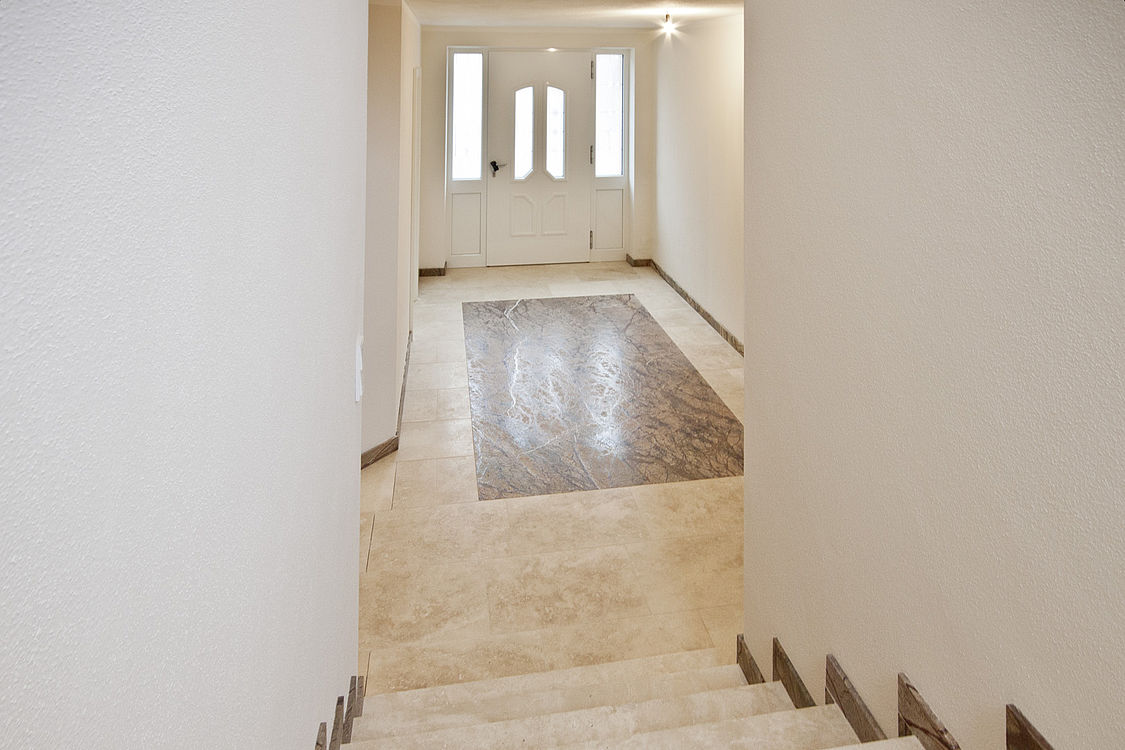
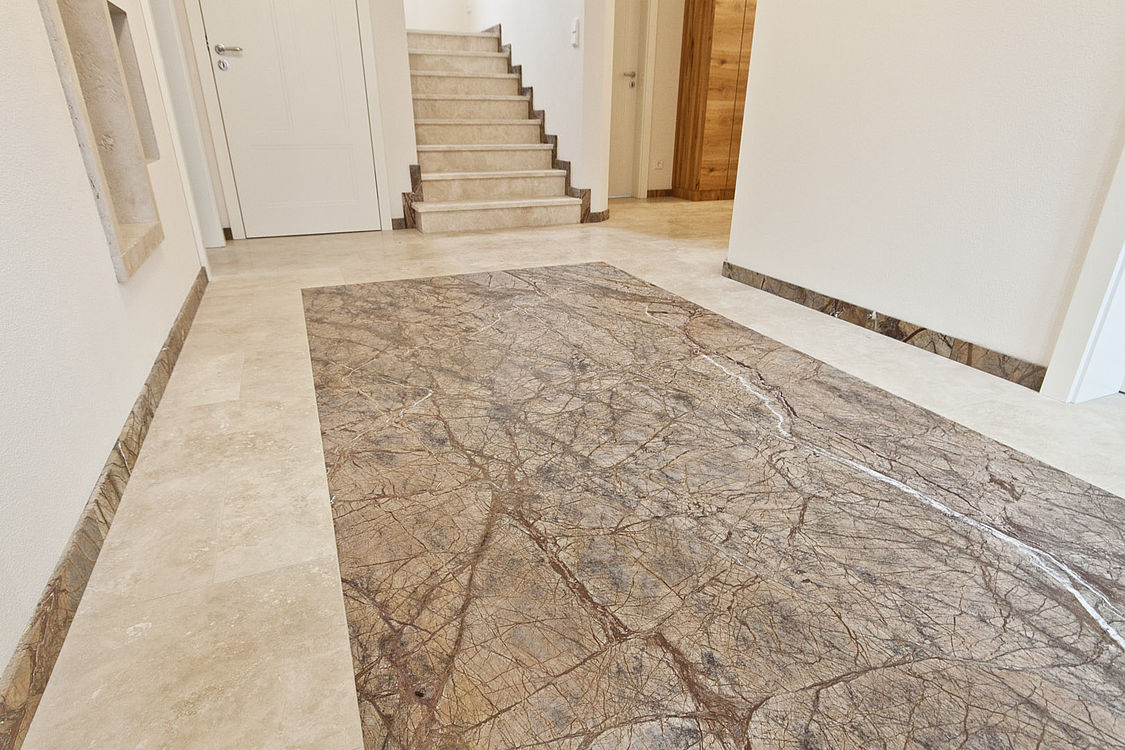
Projects in which Agglomerated stone has been used to great effect.
Agglomerated stone – also known as agglomerated marble, agglomerated granite or terrazzo slabs – are industrially produced surface materials made from natural stone fragments (marble, granite or quartz chippings) bonded with cement or synthetic resin. The natural stone content is typically 90–95 %, the binder 5–10 %.
Production follows the centuries-old Italian terrazzo tradition: crushed natural stone is mixed with binder, pressed into moulds, cured and subsequently ground and polished. Modern agglomerated stone uses vacuum vibration presses (the Bretonstone process) for a particularly dense, uniform compaction.
Two main families: resin-bonded agglomerates (with polyester resin) are denser, non-porous and easy to care for – the variant that dominates interior fit-out today. Cement-bonded terrazzo slabs are harder and more heat-resistant, but porous and in need of impregnation – the classic choice for prestigious floors.
Agglomerated stone deliberately positions itself between natural stone and engineered quartz: it offers genuine natural stone aesthetics with visible fragments, but delivers the industrial reproducibility that is often decisive for large areas or several construction phases.
Typical value ranges for agglomerated stone. The values depend heavily on the binder (resin or cement) and the aggregate — individual brands may differ considerably.
The technical values depend strongly on the binder and on the natural stone content. Resin-bonded agglomerates are non-porous, easy to care for and only conditionally acid-resistant – the resin protects the surface, but marble or limestone chippings in the aggregate react to strong acids. Cement-bonded terrazzo slabs are more porous, but harder and more heat-resistant than the resin-bonded variants. Water absorption ranges, depending on the type, between 0.1 and 3 %. For outdoor use, agglomerated stone is only conditionally suitable – resin-bonded varieties lose colour under UV radiation in the long term, and cement-bonded ones can show cracks in frost.
Agglomerated stone offers a controlled colour palette on a genuine natural stone basis.
Sivec white – fine-grained, bright white. A particularly precise look for window sills, stairs and functional bathroom concepts.
Beige and cream variants – the second strongest colour group, often based on Botticino, Crema Marfil or Jura chippings. Warm, homely, timeless.
Terrazzo looks – large-format natural stone fragments in contrasting colours on a light or dark ground. The EUVAL series brings classic Italian terrazzo in prestigious quality.
Grey and dark agglomerates – based on Bardiglio, Grigio Carnico or black marble breccia. For architecturally restrained concepts and contrast surfaces.
Care depends on the binder.
Resin-bonded agglomerates (the more common variant): about as easy to care for as engineered quartz. No impregnation needed. Warm water and a mild cleaning agent are enough for everyday use. Do not place hot pots directly on the surface – the resin reacts sensitively to temperatures above 150 °C.
Cement-bonded terrazzo slabs: porous; they need impregnation after laying and regular re-treatment. Use exclusively pH-neutral natural stone cleaners. Acidic cleaners, vinegar and lemon juice are to be avoided without exception.
In general: no scouring agents on polished surfaces. Do not expose resin-bonded agglomerates to UV radiation permanently – for outdoor areas they are only conditionally suitable.
Agglomerated stone consists of industrially produced slabs made from 90–95 % natural stone fragments (marble, granite, quartz) bonded with synthetic resin or cement. They offer the look of natural stone with more uniform quality and at a lower price – and are particularly suited to projects in which batch consistency across several construction phases matters.
Terrazzo is the traditional, mostly cement-bonded variant with larger visible pieces of natural stone and a classic Italian character. Agglomerated stone is the umbrella term for all bonded natural stone composites and covers both modern resin-bonded slabs and classic cement terrazzo.
Engineered quartz (Caesarstone or Diresco, for instance) consists of over 90 % ground quartz – that is, of a single mineral, which provides hardness and acid resistance. Agglomerated stone, by contrast, contains visible fragments of various natural stones (marble, granite), mostly in a larger grain size. The look is livelier and closer to natural stone, but the surface is more acid-sensitive, because marble or limestone chippings are present.
Conditionally. Resin-bonded agglomerates are usable in kitchens in principle, but the marble or limestone fragments they contain react sensitively to acids (lemon, vinegar, wine). For intensively used kitchens we recommend engineered quartz, granite or ceramic. For kitchen islands with decorative ambitions and careful handling, agglomerated stone is an aesthetically interesting option.
Resin-bonded agglomerates are easy to care for: warm water and a mild cleaning agent are enough. No impregnation needed. Cement-bonded terrazzo floors require impregnation and pH-neutral cleaners. In both cases, avoid acids and scouring agents – and on resin-bonded surfaces do not place hot pots directly either.
Yes, as a rule considerably. Agglomerated stone offers the look of marble or granite at a fraction of the price and with more uniform quality – ideal for large areas such as floors and stairs, where a consistent appearance is called for.
Rather not. Resin-bonded agglomerates are UV-sensitive – the surface can fade under permanent exposure to sunlight. Cement-bonded terrazzo variants are at risk of cracking in frost. For outdoor areas we recommend natural stone (granite, quartzite) or ceramic.
We carry three agglomerate lines: CTX BasicAgglo (our own brand – inexpensive, with six common decors for interior fit-out), EUVAL (an Italian terrazzo manufacturer with characteristic large fragments) and Italian Premium Agglo (marble and onyx looks of Italian manufacture).