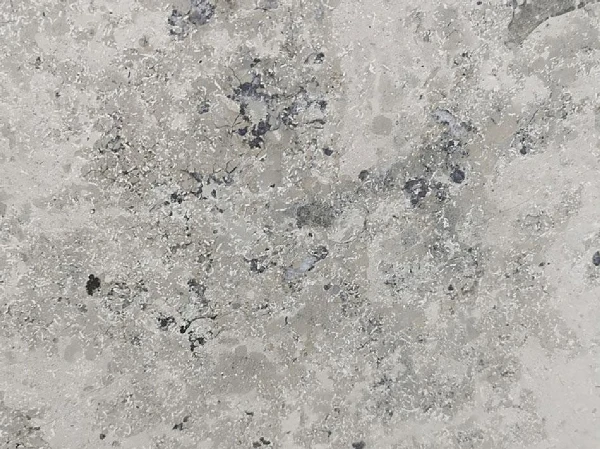
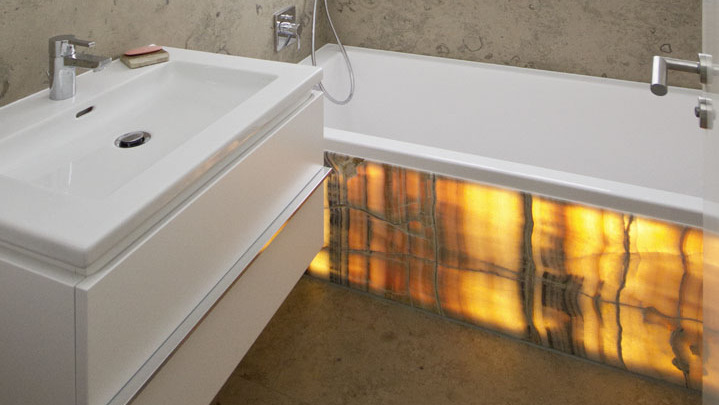
Jura Grau is a grey to blue-grey German limestone from the Altmühltal with a calm, contemporary effect. At ROSSITTIS it is used for window sills, bespoke work, wall claddings and selected interiors with a regional reference.
Limestone
Germany
2.600 kg/m³
Available as: Slabs, Skirting, Tiles and flooring slabs ·
5 of 107 reserved
Other trade names: Blue Limestone, German Limestone Grey, Hampton Grey, Jura blue, Jura grau-blau, Juramarmor, Jurassic Limestone, Limestone Blue, RO-02-022
About Jura grau
Jura Grau is the more restrained, cooler side of the Franconian Jura limestone. Instead of warm yellow tones, a calm grey to blue-grey dominates here, which makes the stone read as matter-of-fact, contemporary and architectural. That is precisely why Jura Grau is a popular choice for window sills, wall claddings, copings and bespoke components. Compared with Jura Gelb it appears less warm and homely, but more sober and clearer. Anyone looking for a German limestone with regional provenance and a contemporary colour will find a highly coherent material here.
The stone comes from the Altmühltal in Germany. On the market it is also known by the colloquial trade name “Jura-Marmor”; petrographically, however, it is a dense, fossil-rich platy limestone from the Upper Jurassic (Weißjura). That is also where its design strength lies: a calm, calcareous material appearance with good workability and a clear regional identity. Against grey granite, Jura Grau reads as softer and more natural; against Pietra Serena, more compact and less sandy. At the same time the stone remains acid-sensitive and, outdoors, markedly more demanding than a hard igneous dimension stone.
Technically the material is sound: bulk density is 2,600 kg/m³, compressive strength 146 MPa and water absorption 0.44 %. Jura Grau is therefore denser and more load-bearing than many users expect of a pale Jura stone. Even so, the stone remains chemically more sensitive than a hard rock, and its suitability for external use can only be judged with reservations. For interiors, sheltered details and precise dimension-stone work the profile is very good; for permanent heavy external exposure, planning should be more restrained.
A honed finish is often the most attractive on Jura Grau, because it emphasises the calm grey tone and generates little reflection. The finishes currently available from stock are listed in the »Finishes« block further down this page. At ROSSITTIS, Jura Grau is available as a raw slab, as tiles, as window sills, skirtings, wall copings, wall cladding and as bespoke components. As an alternative to Pietra Serena it reads as denser and more calcareous; as an alternative to grey granite, markedly softer and more natural.
The frank assessment: Jura Grau is not an acid-proof all-round stone. Anyone seeking maximum robustness, high frost security and complete everyday carefreeness will be better served by granite. Anyone looking for a calm German limestone with a serious dimension-stone presence and regional character, on the other hand, gets a very convincing material in Jura Grau.
In stock
Current availability from our warehouse.
107 slabs in stock — 102 available now, 5 reserved · plus 41 blocks
Thicknesses: 1–3 cm · Finishes: Polished, Satin-honed, Honed C400 and more · Available as: Slabs, Skirting, Tiles and flooring slabs
Guide values for the stone type, taken from manufacturer and test reports. Natural stone is a natural product — individual batches and slabs can differ. For critical applications, request slab-specific test data.
Jura grau is available in a range of finishes. The finish affects appearance, feel and the care it needs.
Polished
Polishing is the most classic finish for marble and limestone — a glossy surface with the highest possible colour intensity and a pronounced depth to the veining. Depending on the mineral composition, the effect can be matte-gloss in places. Acid-sensitive — wine, lemon and vinegar leave etch marks after prolonged contact.
Satin-honed
The surface is brushed — softer minerals are selectively removed, creating a subtle depth and a matte appearance. Strongly veined limestones in particular gain a characterful look and feel this way. The more matte finish conceals small etch marks better than a polish and stands up better to everyday use on heavily used interior surfaces.
Honed C400
Matt appearance created by fine honing with a C400 grit — the level surface shows a clear colour intensity with only minimally visible honing marks (fine honing). Slightly more maintenance-intensive than polished, yet visually very close to polished depth — an elegant matt alternative for demanding exposed surfaces.
Sandblasted + satin-honed
The surface is roughened by sandblasting and then brushed — this creates a level surface with a softer feel than sandblasted alone. The colour appears restrained and the texture is slip-resistant. For demanding outdoor applications in which secure footing is to be combined with a finer tactile quality.
Care & fabrication
Jura Grau should be sealed thoroughly after installation. At 0.44 % water absorption the stone is not extremely open, but as a limestone it clearly benefits from a sealer when it comes to cleaning and care.
For cleaning and care, use pH-neutral natural stone cleaners and a soft cloth. On grey limestone surfaces in particular, limescale-dissolving or acidic cleaners should be consistently avoided.
Vinegar, citrus cleaners, bathroom cleaners and aggressive specialist chemicals are unsuitable. Coffee, wine, oil or acidic foods should be removed promptly from horizontal surfaces.
Particular caution applies outdoors: good drainage, a sheltered construction and a suitable finish matter more than they would with a dense hard rock. Not every limestone application that works without trouble indoors makes sense outdoors.
Frequently asked questions
Is Jura Grau suitable for a kitchen?
Only with the right expectations. Jura Grau reaches 2,600 kg/m³ bulk density, 146 MPa compressive strength and 0.44 % water absorption, but as a limestone it remains acid-sensitive. For kitchens it is genuinely suitable only where care is applied consciously.
What finishes are available in Jura Grau?
The finishes currently available from stock are listed in the »Finishes« block on this page.
Where does Jura Grau come from?
Jura Grau comes from the German Altmühltal. It therefore belongs to the regionally rooted limestones that are firmly established on the German-speaking market.
How do I clean Jura Grau correctly?
pH-neutral natural stone cleaners are mandatory for cleaning and care. Acidic or limescale-dissolving cleaners attack the stone and produce matt patches.
Is Jura Grau frost-resistant?
Outdoors, Jura Grau is suitable only with reservations. The material is rated rather cautiously for external use and should be used there only with a suitable construction and realistic expectations.
Jura Grau or Pietra Serena — which is better?
Pietra Serena is a sandstone and reads as cooler and more Tuscan; Jura Grau is a limestone and usually somewhat denser and more compact in appearance. For regional German dimension-stone applications, Jura Grau is often the more obvious choice.
What does Jura grau cost?
The price depends on the batch, thickness, surface finish and fabrication — with natural stone there is no serious flat rate per square metre. Business customers see prices once their B2B account is activated; private customers receive a complete quote through a fabricator near them.
Projects using Jura grau
Projects in which Jura grau has been used successfully.