Chloritschiefer from Austria

Listed in our range under Slate.

Pannonia Grün gewolkt

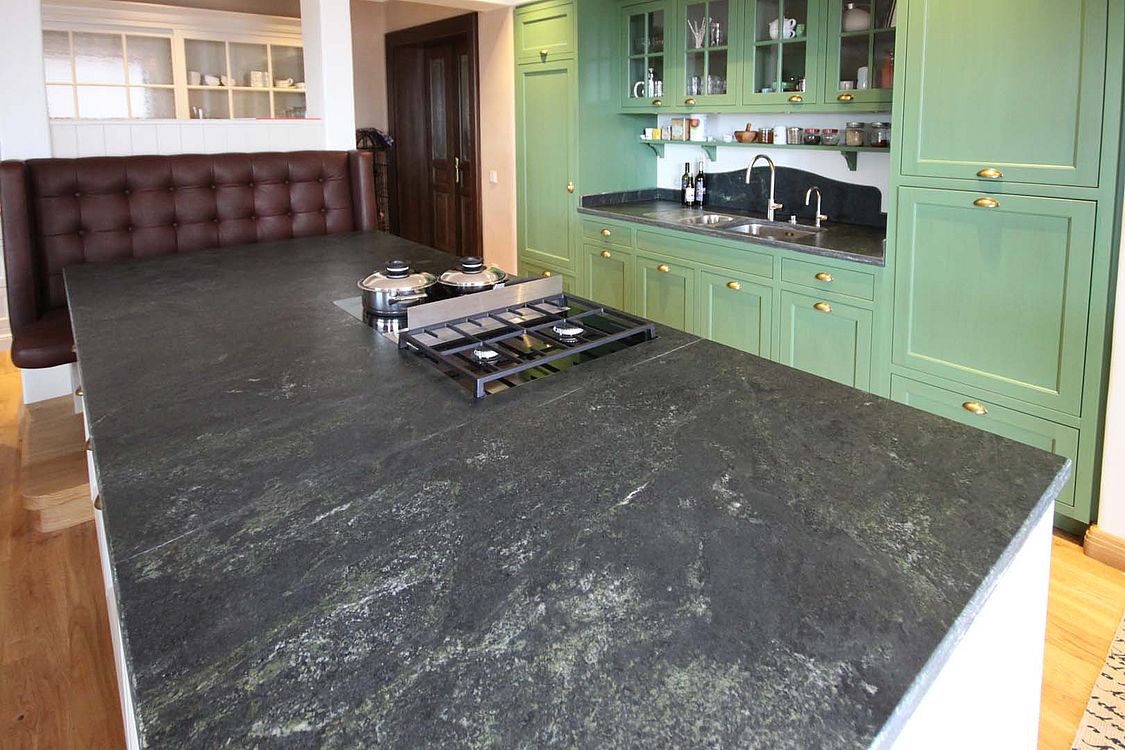
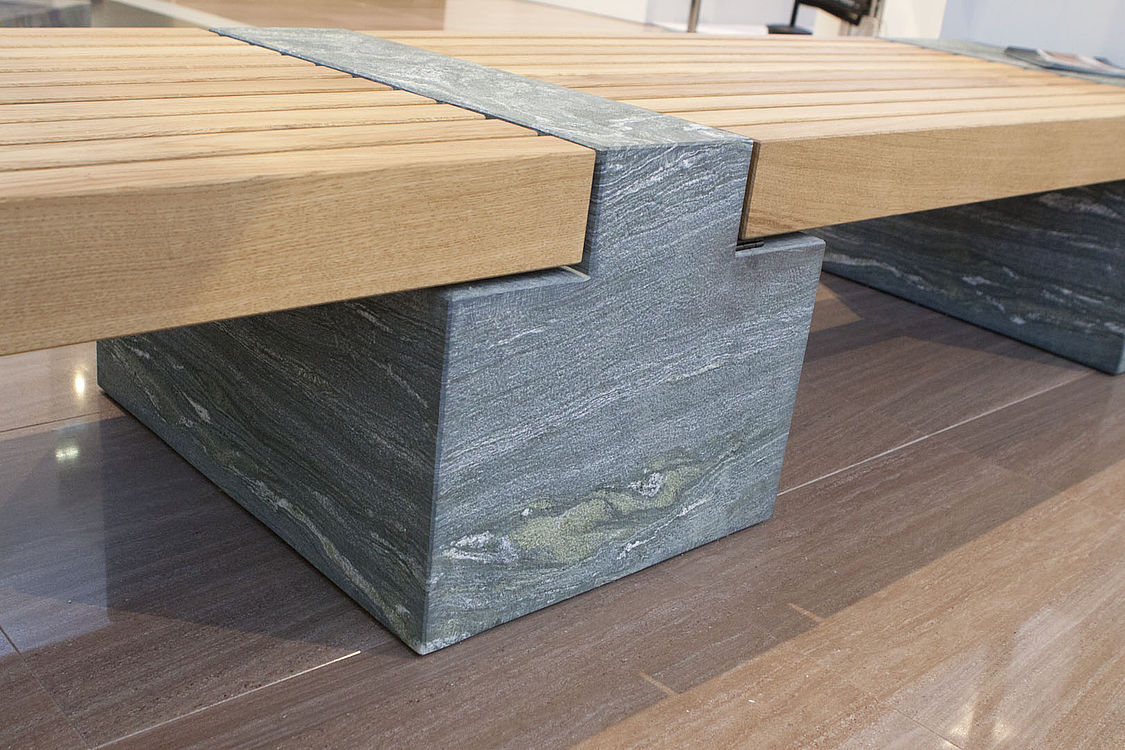
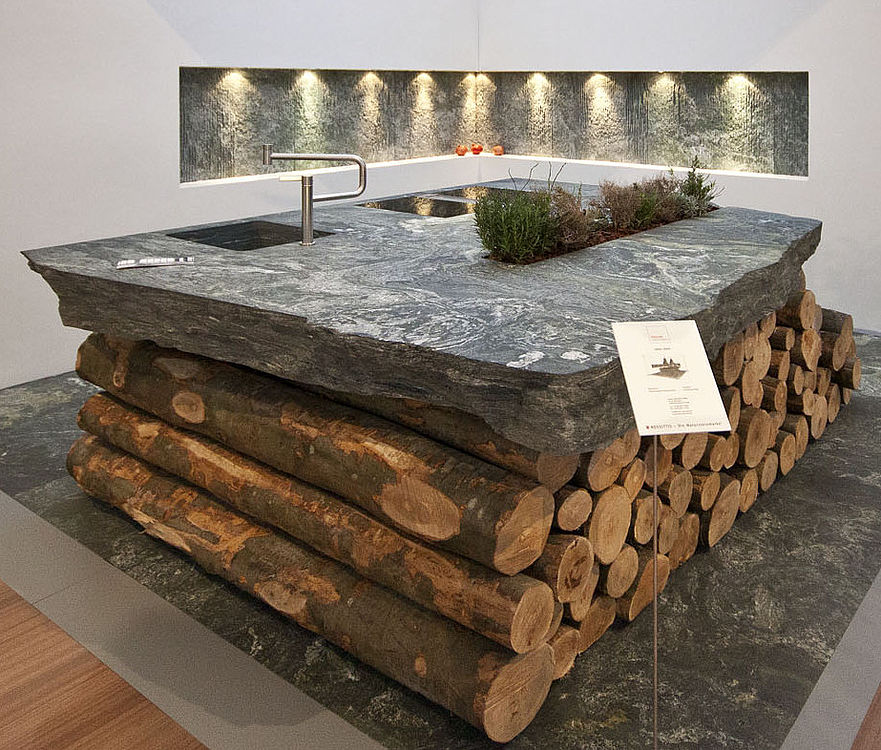
Pannonia Grün gewolkt (also “Grünschiefer”, “Rechnitzer Grünschiefer”, “Royal Green” or “Pannonia Verde”) is a classic Austrian chlorite schist from the Geschriebenstein/Rechnitz quarrying area in Burgenland — petrographically a metamorphic schist with a high chlorite content as the carrier of its characteristic green colouring. The slab shows a deep green-anthracite dimension-stone ground tone with characteristic cloudy, flowing figuring in the finished surface, isolated lighter greenish mineral areas and subtle silvery lustrous mica layers. At ROSSITTIS we fabricate Pannonia Grün gewolkt into durable facade elements, stairs, internal and external floors, wall claddings, window sills, pool surrounds and Mediterranean-Alpine dimension-stone applications with a distinctively Austrian green natural stone effect.

Petrographisch ein Chloritschiefer (Grünschiefer-Familie) – ein metamorphes Schicht­gestein mit hohem Chlorit-Anteil als Hauptmineral (Träger der charakteristischen grünen Färbung durch Eisen-Anteil), ergänzt durch Quarz, Plagioklas, Glimmer (Muskovit) und vereinzelt Epidot und Calcit. Die Lagerstätte befindet sich im Steinbruch­gebiet Geschriebenstein/Rechnitz in der Provinz Burgenland (Österreich, an der ungarischen Grenze). DNSA-Eintrag: #5347. Verbreitete Handels­namen: „Pannonia Grün", „Grünschiefer", „Rechnitzer Grünschiefer", „Royal Green", „Pannonia Verde". „Pannonia" verweist auf die historische Pannonische Region (das heutige Burgenland). Im internationalen Stein­handel wird die Sortierung häufig fälschlich als Quarzit geführt – petrographisch ist sie aber ein Chloritschiefer mit Mohs 4 – 5 (deutlich weicher als Quarzit) und mit eingeschränkter Säure­beständigkeit (einzelne Mineralbestandteile sind nicht dauerhaft säure­fest). Material­bedingt nur matte oder satinierte Oberflächen erreichbar – keine Hochglanz-Politur möglich.

Chloritschiefer Austria 2.930 kg/m³
Available as: Slabs · 13 of 20 reserved

Other trade names: Alpengrün Alpenwelt, Amazonia, GRÜNSCHIEFER, Pannonia Green, Pannonia Grün, Pannonia Grün gewolkt, Pannonia Verde, Rechnitz Green, Rechnitzer Grünschiefer, Royal Green, Yuva Lapis

About Pannonia Grün gewolkt

Background. Pannonia Grün gewolkt is one of the most significant Austrian dimension stones and has for decades been among the classic central European natural stone selections for demanding facade and floor applications. In the DNSA (German Natural Stone Archive) the stone is documented as entry #5347. In international stone trading the selection is offered under several trade names: “Pannonia Grün”, “Pannonia Grün gewolkt”, “Grünschiefer”, “Rechnitzer Grünschiefer”, “Geschriebenstein-Schiefer”, “Royal Green” and “Pannonia Verde”. The suffix “gewolkt” (clouded) describes the characteristic cloudy figuring of the finished slab. “Pannonia” refers to the historic Pannonian region (today's Burgenland), known in Roman antiquity as the province of Pannonia.

In stock

Current availability from our warehouse.

Technical data

Guide values for the stone type, taken from manufacturer and test reports. Natural stone is a natural product — individual batches and slabs can differ. For critical applications, request slab-specific test data.

Rohdichte 2.930 kg/m³
Druckfestigkeit 94,8 MPa
Biegezugfestigkeit 19,9 MPa
Wasseraufnahme 0,34 %
Säurebeständig Nein

Finishes

Pannonia Grün gewolkt is available in a range of finishes. The finish affects appearance, feel and the care it needs.

Poliert

Politur ist im Schiefersegment selten — wenn vorhanden, eine glänzende Oberfläche mit ausgeprägter Farbintensität und kontrastreicher Mineralwirkung. Da Schiefer schichtig aufgebaut ist, kann die Politur stellenweise nur mattglänzend wirken. Eine designorientierte Veredelung für gestaltete Sichtflächen mit Statement-Charakter.

Satiniert

Die Oberfläche wird gebürstet — weichere Minerale werden gezielt entfernt, es entsteht eine subtile Tiefe mit mattem Erscheinungsbild. Eine zurückhaltende Veredelung, die die schieferspezifische Schichtung in eleganter Mattigkeit zeigt. Pflegeleichter als die polierte Variante und alltagstauglich.

Care & fabrication

Cleaning. In everyday use, warm water, a soft cloth or a clean mop and a pH-neutral natural stone cleaner are sufficient. Mild general-purpose cleaners without any acid content and mild washing-up foam are suitable.

Do not use. Strongly acidic cleaners (descalers, bathroom cleaners with an acid content, WC cleaners, alloy wheel cleaners) — individual mineral constituents of Pannonia Grün (in particular chlorite and calcite fractions) are not permanently acid-resistant and can be locally attacked by acid exposure. Aggressive scouring pads or abrasive pastes are likewise out of the question, because at Mohs 4–5 chlorite schist is markedly softer than granite or quartzite and can be mechanically scratched.

Sealing. Recommended for all external applications, floor applications and areas with a risk of water or soiling. A premium sealer with silane/siloxane-based stone protection guards against water uptake and pigment ingress, but cannot remove the acid sensitivity of the individual mineral constituents. The sealer should be refreshed regularly (every 3–5 years depending on loading). Important: avoid film-forming polishing, wax or oil products, because they alter the matt character of the material and make later care more difficult.

Facades. The classic application, with a deep tradition in Austria and central Europe. Pannonia Grün is DNSA-confirmed frost-resistant and can be installed as a ventilated facade panel, as external wall cladding with factory-fitted edge anchoring, or as a mortar-bedded facade panel in a sheltered construction. In spring we recommend cleaning with clear water to remove road salt residues and winter deposits.

Floors and stairs. With a compressive strength of 94.8 MPa, a flexural strength of 19.9 MPa and an abrasion group of 10.3, Pannonia Grün is suitable for moderately to heavily used floor applications. The finishes currently available from stock are listed in the »Finishes« block further down this page.

Kitchen. Recommended only with reservations. The acid sensitivity (individual mineral constituents are not permanently acid-proof) and the medium Mohs hardness of 4–5 mean that the selection is NOT the first choice for heavily acid-loaded kitchen worktops. Anyone wanting the green appearance in the kitchen should wipe up consistently and choose a premium sealer. For a fully acid-proof green kitchen worktop we recommend switching to true green quartzites or to a porcelain with a green dimension-stone character.

Outdoors and frost. Fully suitable (DNSA-confirmed). The stone is frost- and de-icing-salt-resistant and can be used as a ventilated facade panel, external wall cladding, pool surround, external floor covering and terrace slab — Pannonia Grün is one of the classic central European external dimension stones with a long track record.

Scratches and repair. At Mohs 4–5 the stone is moderately scratch-resistant. Deeper damage or matt patches can be locally reworked by regrinding with fine diamond pastes — this is work for a specialist stonemason or joint-technology firm. Isolated mica layers can partially flake under very heavy mechanical loading — that is inherent to the material and part of the character of this schist.

Frequently asked questions

What kind of material is Pannonia Grün gewolkt?

Petrographically a chlorite schist (greenschist family) — a metamorphic layered rock with a high chlorite content as its principal mineral, supplemented by quartz, plagioclase, mica and occasional epidote. The characteristic green colouring arises from the iron in the chlorite mineral. The deposit lies in the Geschriebenstein/Rechnitz quarrying area in the province of Burgenland (Austria, on the Hungarian border). DNSA entry: #5347.

What trade names are used for this selection?

The selection is offered under several trade names: “Pannonia Grün”, “Pannonia Grün gewolkt”, “Grünschiefer”, “Rechnitzer Grünschiefer”, “Geschriebenstein-Schiefer”, “Royal Green” and “Pannonia Verde”. “Pannonia” refers to the historic Pannonian region (today's Burgenland).

What exactly does Pannonia Grün gewolkt look like?

A deep green-anthracite dimension-stone green as the ground tone, crossed by characteristic cloudy, flowing figures with isolated lighter greenish mineral areas and subtle silvery lustrous mica layers. From a middle distance the surface reads as a calm deep green dimension-stone field with a cloudy depth.

What technical values does Pannonia Grün gewolkt have?

DNSA values (#5347): bulk density 2,930 kg/m³ (above average), compressive strength 94.8 MPa, flexural strength 19.9 MPa, water absorption 0.34 %, abrasion group 10.3 cm³/50 cm², Mohs hardness approximately 4–5. Frost-resistant (DNSA-confirmed). Acid-resistant with reservations: individual mineral constituents (chlorite, calcite fractions) are not permanently acid-proof.

Is Pannonia Grün a quartzite?

In international stone trading the selection is frequently assigned to the quartzite family — petrographically the correct designation is chlorite schist (a metamorphic layered rock with a high chlorite content). This classification matters for the application: unlike pure quartzites, chlorite schist is more acid-sensitive and, at Mohs 4–5, softer.

Can Pannonia Grün be polished?

Only to a limited extent, for reasons inherent to the material. The selection achieves only a matt or satin-honed surface — no high-gloss polish as with granite or quartzite. This matt minerality is part of its character and should be allowed for in the design.

Is Pannonia Grün gewolkt suitable for a kitchen?

With reservations. The acid sensitivity (individual mineral constituents are not permanently acid-proof) and the medium Mohs hardness (4–5) mean that the selection is NOT the first choice for heavily acid-loaded kitchen worktops. Wine, vinegar, lemon and tomato juice can leave local matt patches if allowed to act for a prolonged period. For a fully acid-proof green kitchen worktop we recommend switching to true green quartzites or to a porcelain.

Is Pannonia Grün gewolkt suitable for external applications?

Yes, fully. Pannonia Grün is DNSA-confirmed frost-resistant and is one of the classic Austrian and central European external dimension stones with a long track record. The classic application is as a ventilated facade panel, external wall cladding, pool surround, external floor covering and terrace slab. For slip-resistant external applications we recommend the flamed or bush-hammered variant.

Projects using Pannonia Grün gewolkt

Projects in which Pannonia Grün gewolkt has been used successfully.

Pannonia Grün Küchen

Pannonia Grün

Hauser Naturstein

Pannonia Grün Anderes

Pannonia Grün

Natursteine Feldbusch

Pannonia Grün Anderes

Pannonia Grün

Hauser Naturstein

Check the live stock Request an appointment