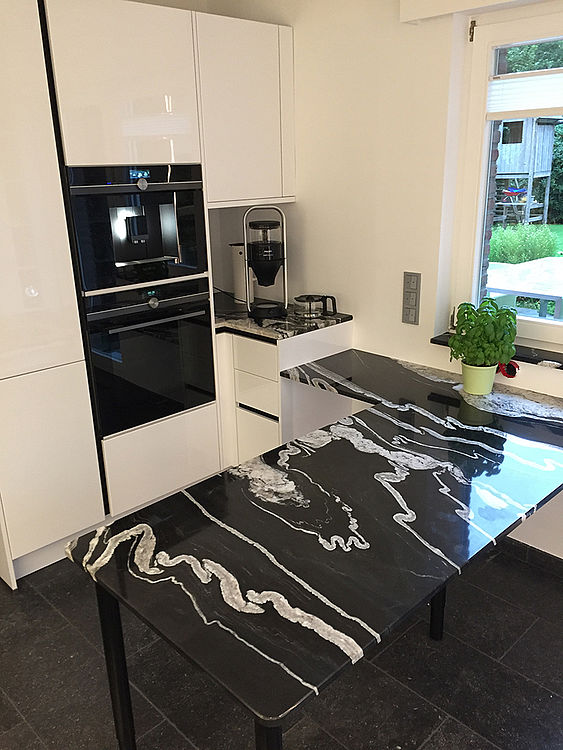
Bondi Beach is a Brazilian gneiss with a deep black to anthracite ground mass and high-contrast pale, wave-like vein bands. Petrographically a high-grade metamorphic silicate rock of the granite family, traded as a granite — an acid-resistant hard rock for kitchen worktops, wall cladding, floors, stairs and prestige interior and exterior applications.
Petrographically a gneiss from Brazil — a highly metamorphically overprinted silicate rock with a characteristic banded structure. Listed in the trade as granite.
Other trade names: Black Horse, Bondi Beach (Dynamic Stone), Copacabana, Dynamic Stone Bondi Beach, Panda White, RO-01-592, Skyfall
About Bondi Beach
Bondi Beach comes from Brazil, one of the world's most important suppliers of metamorphic hard rocks. Petrographically it is a gneiss — a silicate rock overprinted by high-grade metamorphism with a characteristically directional banded structure, recrystallised deep in the earth's crust from older granitoids or sediments under pressure and heat. In international stone trading the grade is carried, like almost all Brazilian gneisses, as a granite — a convention established on the market that corresponds to the technical resilience and the acid-resistant mineral profile of this rock family.
The slab pattern shows a dramatic alternation of deep black to anthracite bands and light grey to cream-white lightenings that run across the slab in flowing, wave-like movements. The pale veining recalls the movement of waves on a beach — an association alluded to by the trade name 'Bondi Beach'. The movement of the banding is, as is typical of the material, flowing rather than strictly linear, with irregular courses and fine mineral concentrations that give every slab its own appearance. In bookmatch installation — mirror-image installation of adjacent slabs — particularly impressive, almost surreal large-scale patterns arise with a symmetrical wave movement; Bondi Beach is one of the strongest bookmatch grades among the Brazilian gneisses.
Technically the stone shows the values of high-quality Brazilian gneisses: bulk densities typically around 2,700–2,800 kg/m³, compressive strengths above 150 MPa, good flexural strength and very low water absorption well below 0.5 %. As a silicate rock, Bondi Beach is fully acid-resistant — lemon juice, vinegar, wine, cola and other acids leave no etch marks. The stone is frost-resistant, heat-resistant and suitable for intensive interior and exterior applications. The high-contrast appearance harmonises particularly with pale timber, brass and bronze accents, clear white and restrained black.
In interior fit-out, Bondi Beach is a strong choice for statement applications: kitchen worktops and islands with bookmatch mirroring, prestige wall cladding in living spaces, hotel lobbies and entrance areas, bar counters and counter fronts, bathroom feature walls, table and console tops as well as fireplace surrounds. Outdoors it finds use in façade cladding, plinths and steps with proper sealing. Its full acid resistance qualifies it without reservation for intensive kitchen applications — unlike acid-sensitive black-and-white marbles such as Calacatta Black or Nero Marquina.
In stock
Current availability from our warehouse.
22 slabs in stock · plus 5 blocks
Thicknesses: 2 cm · Finishes: Polished · Available as: Slabs
Bondi Beach is available in a range of finishes. The finish affects appearance, feel and the care it needs.
Polished
Polishing is the most classic finish in the hard stone segment — a mirror-smooth, high-gloss surface with the highest possible colour intensity and maximum depth effect in the mineral structure. As an acid-resistant silicate stone, polished granite is easy to care for and the first choice for kitchen worktops, wall claddings and prestigious exposed surfaces.
Care & fabrication
As a silicate rock, Bondi Beach is fully acid-resistant — lemon juice, vinegar, wine, cola and other acids do not attack the stone. That makes it considerably easier to look after than carbonate rocks such as marble or limestone. For daily cleaning, warm water and a pH-neutral natural stone cleaner are sufficient; aggressive household cleaners and abrasive sponges should be avoided as a matter of principle, since they can attack the polished surface mechanically. Professional sealing after installation is recommended on kitchen worktops and exposed surfaces — it protects against oil stains (coffee, olive oil, red wine) and makes daily care easier. Hot pans are unproblematic for short periods; where heat acts permanently, trivets are advisable. On the dark high-gloss surface, water drops and cleaning streaks are clearly visible — clean, lint-free cloth material should be used when wiping. Outdoors, re-sealing every 2–3 years is sensible.
Frequently asked questions
What kind of rock is Bondi Beach?
Bondi Beach is petrographically a gneiss from Brazil — a silicate rock overprinted by high-grade metamorphism with a characteristic banded structure. In the stone trade it is carried, like most Brazilian gneisses, as a granite. As a silicate rock it is fully acid-resistant and technically markedly more robust than marbles or limestones.
Where does Bondi Beach come from?
Bondi Beach comes from Brazil, one of the world's most important exporters of natural building stone. The Brazilian hard rocks are quarried in regions such as Minas Gerais, Espírito Santo and Bahia and have been supplied to the European market for decades.
Is Bondi Beach suitable for kitchen worktops?
Yes, without restriction. As a fully acid-resistant silicate rock, Bondi Beach is very well suited to kitchen worktops — unlike acid-sensitive black-and-white marbles such as Calacatta Black or Nero Marquina, wine, lemon juice or vinegar leave no etch marks. Sealing after installation is recommended.
Is Bondi Beach suitable for bookmatch installation?
Outstandingly so. In mirror-image installation of adjacent slabs, the flowing, wave-like veining creates particularly impressive, almost surreal large-scale patterns with a symmetrical wave composition. Bookmatch wall cladding in Bondi Beach is among the most dramatic statement applications for hotel lobbies, bar counter back walls and exclusive residential feature walls. The sample and the choice of slabs should be viewed before installation.
Is Bondi Beach suitable for external applications?
Yes. As a dense hard rock with low water absorption, Bondi Beach is frost-resistant and suitable for façades, plinths, steps and entrance areas. Proper sealing is recommended outdoors in order to reduce the take-up of soiling and weathering effects over the long term.
Which slab formats are usual for Bondi Beach?
Brazilian gneisses are available as large slabs in standard formats of typically 280–320 × 160–200 cm at thicknesses of 2 cm and 3 cm. Through ROSSITTIS, special thicknesses as well as tile formats for floors are also sourced. Please enquire directly about specific availability.
What does Bondi Beach cost?
The price depends on the batch, thickness, surface finish and fabrication — with natural stone there is no serious flat rate per square metre. Business customers see prices once their B2B account is activated; private customers receive a complete quote through a fabricator near them.
Projects using Bondi Beach
Projects in which Bondi Beach has been used successfully.